
Most customer research dies in the time between the interview and the decision. By the time a team has recruited, moderated, transcribed, synthesized, and socialized findings, the market has already moved, and the competitor who learned faster is already shipping the next answer. That's why AI agents for customer research matter: they give you a customer-intelligence layer that runs continuously instead of once a quarter, which is worth far more than a faster survey hack.
I've been building with ML since 2016 and generative AI since 2019, and the pattern is always the same. Teams say they want to “understand customers better,” then hand an agent a vague prompt and expect strategy to fall out of the sky. It doesn't work that way. Agents need a decision, a deadline, a segment, and evidence rules, or they'll produce polished noise.
Table of Contents
- Why Most Customer Research Is Already Broken
- Sourcing and Ingesting the Raw Signal
- Designing Agent Roles and Prompts
- Orchestration Patterns That Actually Fit Research
- When to Use Real Humans Instead of Synthetic Insights
- Evaluation, Governance, and Making It Auditable
- Your 30-Day Rollout and What to Ship First
Why Most Customer Research Is Already Broken
Traditional research breaks in the exact places you care about most. It's slow, it's episodic, and it usually gets filtered through too many layers before anyone makes a call. If your team is still running customer discovery like a quarterly ritual, you're already behind the teams that treat customer signals like live infrastructure.
The fishbowl problem nobody likes to name
In practice, even a well-run interview can distort reality. The moment a prospect knows they're in a research conversation, they start performing, simplifying, or politely avoiding the sharpest edge of their objections. That's the fishbowl effect, and it's one reason I don't trust a single clean transcript unless it's triangulated against support tickets, public reviews, CRM notes, and actual customer language.
The market is also moving on a much tighter loop than most research functions. AI agents are already being used to automate discovery tasks like interview synthesis, sentiment tagging, and rapid market scanning, which fits the broader market expansion signaled by the AI agents market estimate of USD 7.63 billion in 2025 and a projection to USD 182.97 billion by 2033, a 49.6% CAGR from 2026 to 2033, according to Grand View Research. A separate estimate puts the sector at USD 5.40 billion in 2024 and USD 50.31 billion by 2030, which reinforces the same direction of travel.
A practical rule: if your research process can't keep up with the cadence of pricing tests, churn signals, and launch feedback, you have a report factory rather than an insight system.
From vague curiosity to agent-executable goals
The fastest way to waste an agent is to ask it to “understand our customers better.” That sentence is too broad to execute and too fuzzy to audit. A good research brief names the segment, the decision, the question taxonomy, and the evidence type you want back.
Use a SaaS pricing-page relaunch as the model. The core question is which objections kill conversion, which features are essential by segment, and what exact buyer language should show up in headlines, FAQs, and proof points. Whether buyers “like the page” matters far less. If the agent can't return verbatim objections and contextualized themes, the output won't help revenue.
Here's the one-page goal brief shape I use:
- The decision this research will inform.
- The deadline when the decision has to be made.
- The segment the research must reflect.
- The sample, meaning the evidence pool that is acceptable.
- The evidence format: quotes, theme clusters, preference splits, or issue lists.
| Research Data Source Trade-offs | Source | Signal Quality | Ingestion Cost | Best For |
|---|---|---|---|---|
| Internal feedback | Support tickets, CRM notes, call transcripts | High | Medium | Churn, objections, recurring pain |
| Public conversation | Reviews, Reddit, G2, community threads | Medium to high | Medium | Language mining, market patterns |
| Live customer interviews | AI-moderated or human-led sessions | Highest | Higher | Pricing, positioning, onboarding, trust |
If you want a practical starting point, I've laid out a working research stack in this guide on AI tools for market research. The point is making sure the agent has a real problem to solve instead of a vague mandate to improvise around.
When you do this correctly, customer research stops being a retrospective report and becomes a live decision layer. That's the shift competitors miss. If they learn in 48 hours what takes you 8 weeks, they own the next quarter.
Sourcing and Ingesting the Raw Signal
The raw signal usually lives in places teams already ignore because it's messy. Support tickets, review sites, CRM notes, call transcripts, community threads, Reddit, and G2 comments tell you what customers care about when nobody is watching. An agent is only useful if it can retrieve from those corpora instead of hallucinating a persona from model memory.
Build the ingestion path before you build the prompt
I start by generating 10 to 20 pain-framed search queries around a decision, not a feature list. Then I collect 100 to 200 unique comments before drawing conclusions, because smaller samples produce misleading patterns and overfit fast. Each item gets labeled with the raw quote, surrounding context, source type, and a short note on why it matters before I let the system cluster themes.
That workflow matters because customer language is rarely clean. One buyer says “too expensive,” another says “not worth the migration risk,” and a third says “I can't justify this to finance.” Those are not the same objection, and a good agent must preserve that difference before collapsing them into a neat theme.
A lightweight stack is sufficient for any team. Use scraping for public sources, transcription for calls, deduplication for repeated comments, and a vector store for retrieval across the corpus. Keep the pipeline boring. Reliability beats novelty here, because the agent's job is to recover evidence, not show off with a fancy interface.
The moment your agent starts summarizing without traceable retrieval, you've left research and entered fiction.
Where the signal belongs and where it doesn't
Not every source deserves the same weight. Internal support data is usually the cleanest route to friction patterns, while public threads are better for language discovery and category-level perception. Live interviews still matter when the decision is about pricing, onboarding, or product-market fit, because those are revenue decisions, not curiosity exercises.
A useful rule is simple. If the signal can affect a roadmap, a message, or a retention play, store it with provenance and preserve the original wording. If it can't be traced back to a real customer or real market conversation, treat it as a hypothesis, not evidence.
One more practical note. I'd rather have a smaller, well-tagged corpus than a giant dump of unstructured text. What counts is whether the agent can answer a specific question with enough context to help someone make money or avoid losing it. Volume doesn't.
Designing Agent Roles and Prompts
A single general-purpose agent can do decent work, but it breaks in predictable ways. It over-reaches on evidence, drifts from the brief, or merges too many jobs into one pass and starts losing context. I prefer a multi-role setup because each role exists to kill one failure mode.
Four roles that actually map to research work
The Planner breaks the research question into sub-questions, segments, and output requirements. The Retriever pulls evidence only from approved sources. The Coder/Analyst tags, clusters, and compares signals across the corpus. The Writer turns the result into a brief you can act on. Then a Critic scores the draft against the goal brief and flags anything unsupported.
That structure is the difference between an agent that sounds smart and an agent that helps a team decide faster. Each role narrows one risk. The Planner prevents wandering. The Retriever prevents made-up evidence. The Analyst keeps themes grounded. The Writer forces clarity. The Critic keeps everyone honest.
For the context layer, the decisions matter as much as the prompts. I'm explicit about what the Retriever can and can't use, what counts as acceptable provenance, and what it should do when the evidence is thin. That's the same mindset I use in context engineering, because a good agent stack is mostly disciplined constraint design.
A Retriever prompt that won't wander
A practical Retriever prompt looks like this:
Role: You retrieve only evidence relevant to the goal brief.
Inputs: goal brief, source list, segment definition, query list.
Task: Find verbatim evidence that answers the decision question.
Rules: Use only retrieved sources. Preserve exact wording. Include surrounding context. Reject weak matches. If you can't find evidence, write “Insufficient data found.”
Output: source, quote, context, why it matters, confidence label.
That last line is the one many teams skip. Confidence labeling forces the agent to surface whether a claim is confirmed by multiple independent sources, supported by a single source and should be verified, or has no source at all. I want that because the business cost of a polished falsehood is higher than the cost of a slower answer.
If you want a production-minded reference point, the publisher's own AI research agent resource makes the same core point. Don't trust model memory. Force source retrieval. Force traceability. Refuse missing sections instead of inventing them. That's how you keep the workflow decision-safe.
Orchestration Patterns That Actually Fit Research
Overcomplicating orchestration often stems from the assumption that more agents automatically yield better research. Usually this just means more moving parts, more latency, and more opportunities for the system to wander. The right pattern depends on whether the question has a known shape or not.
Pick the simplest flow that answers the question
A sequential chain works best when the output is predictable, like interview synthesis from an already-defined corpus. The Retriever collects evidence, the Analyst groups it, and the Writer produces the brief. Clean, fast, easy to debug.
A parallel setup makes sense when you need breadth, especially across segments. One agent per segment lets you compare objections for SMB, mid-market, and enterprise without forcing one pass to flatten everything into one average answer. If you're comparing product perception by buyer type, this is the pattern that surfaces differences instead of hiding them.
A supervisor loop fits open-ended discovery. The supervisor checks whether the brief is decision-grade, then sends the work back if the evidence is thin or the themes are too generic. That's the right move when you don't know the answer shape in advance and need the system to refine until it does.
When one agent beats five
A fancy orchestration graph isn't always the answer. If you're synthesizing a narrow set of interviews or reviewing a small public corpus, a single well-prompted agent can be faster, cheaper, and easier to audit. I only reach for multi-agent orchestration when the question benefits from separation of duties.
Latency matters too. In a research loop, every extra hop adds time and usually adds some chance of context loss. That's why I prefer one simple chain first, then I add parallelism only when segment comparison or evidence coverage justifies it.
If you want to see how I think about this pattern in operational terms, I've written about AI agent orchestration. The short version is simple. Pick the fewest roles that produce decision-grade output, then make the supervisor brutal about unsupported claims.
Here's the operational logic I use:
A decision rule: if the problem is synthesis, chain it. If the problem is comparison, parallelize it. If the problem is ambiguity, supervise it.
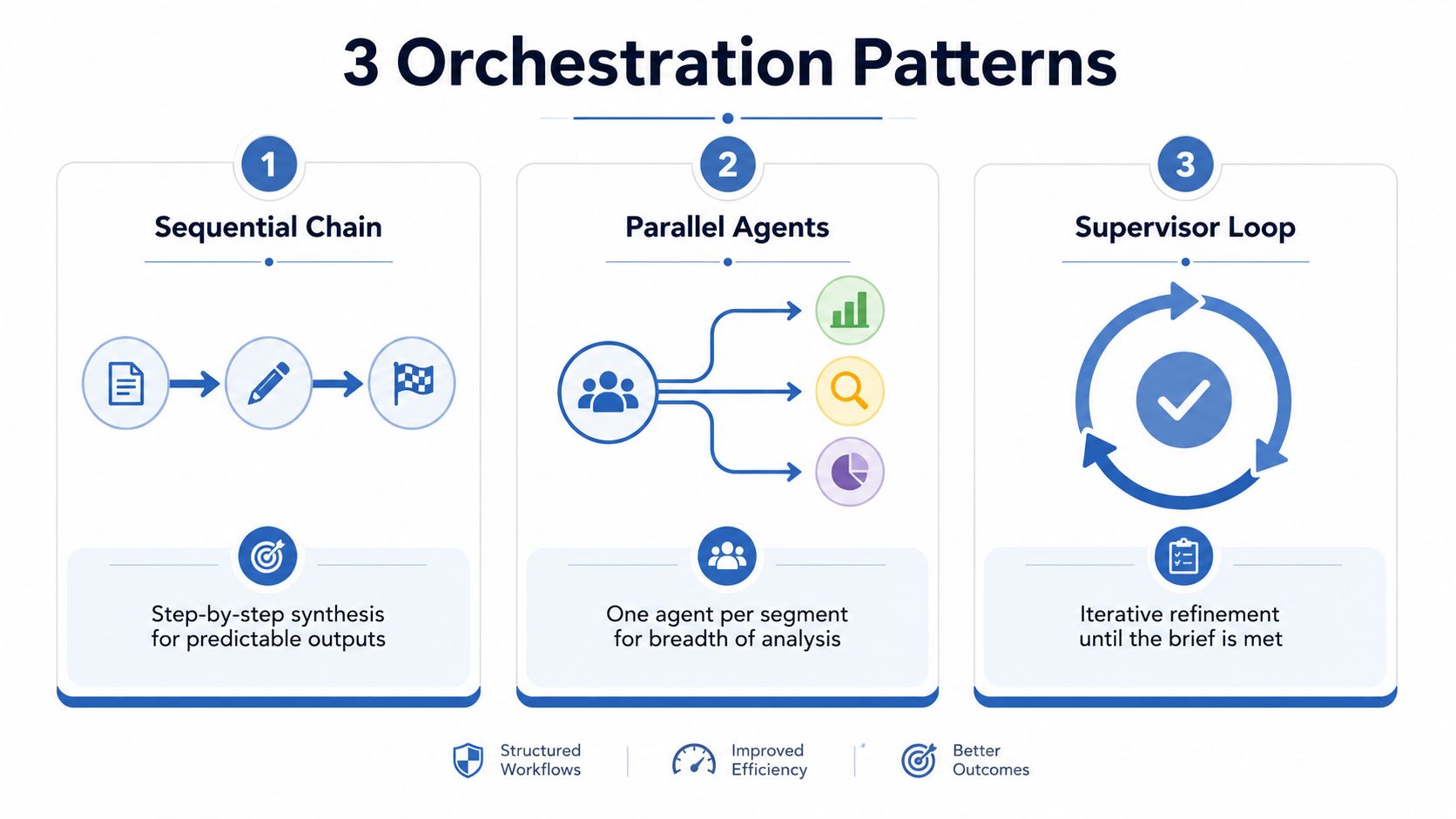
The right orchestration pattern makes research usable, if never glamorous. That's what matters when the outcome is a pricing page, a churn fix, or a launch message.
When to Use Real Humans Instead of Synthetic Insights
Synthetic buyers can be useful. They're fast for idea generation, copy exploration, and early hypothesis testing, especially when you need a rough directional read before spending money on real recruiting. They're also dangerous if you let them stand in for actual customer reaction on revenue-sensitive decisions.
The line between exploration and decision
There's a real split in the market right now. Some tools run the full interview loop with AI-moderated real participants, while others lean on simulated panels and claim they can approximate customer response. That distinction matters because synthetic panels tend to echo familiar stereotypes, miss novelty, and create false confidence when the question is specific to your product.
A pricing page is the cleanest example. A synthetic model can help you brainstorm objections, but it can't tell you how a real prospect responds to your actual offer stack, your refund flow, or the friction in your onboarding. Those are customer-specific questions, and they deserve real people.
My rule is blunt. If the decision affects revenue, ship the change to real humans first. If the goal is exploration, synthetic is fine. Treat it as a risk control.
Why methodology matters more than speed
The argument for real people is that synthetic methods can only be trusted inside narrow lanes. They're useful when the target is a rough idea, a content angle, or a concept library. They fail when you need to know how the market will behave against a specific offer.
Many teams get lazy. They grab a simulated answer because it's quick, then treat it like evidence. That shortcut can save a day and cost a quarter. If the output changes pricing, conversion, retention, or onboarding, you need a real signal path.
Use synthetic to explore. Use real people to decide.
That distinction also keeps teams from over-investing in the wrong research motion. When the question is open-ended, synthetic can accelerate the first pass. When the question is customer-specific, the only trustworthy signal is the market itself.
Evaluation, Governance, and Making It Auditable
Speed doesn't help if the agent fabricates a quote or buries a weak sample. The core question is whether your research output can survive legal review, product review, and a skeptical business partner. If it can't, it isn't decision-safe yet.
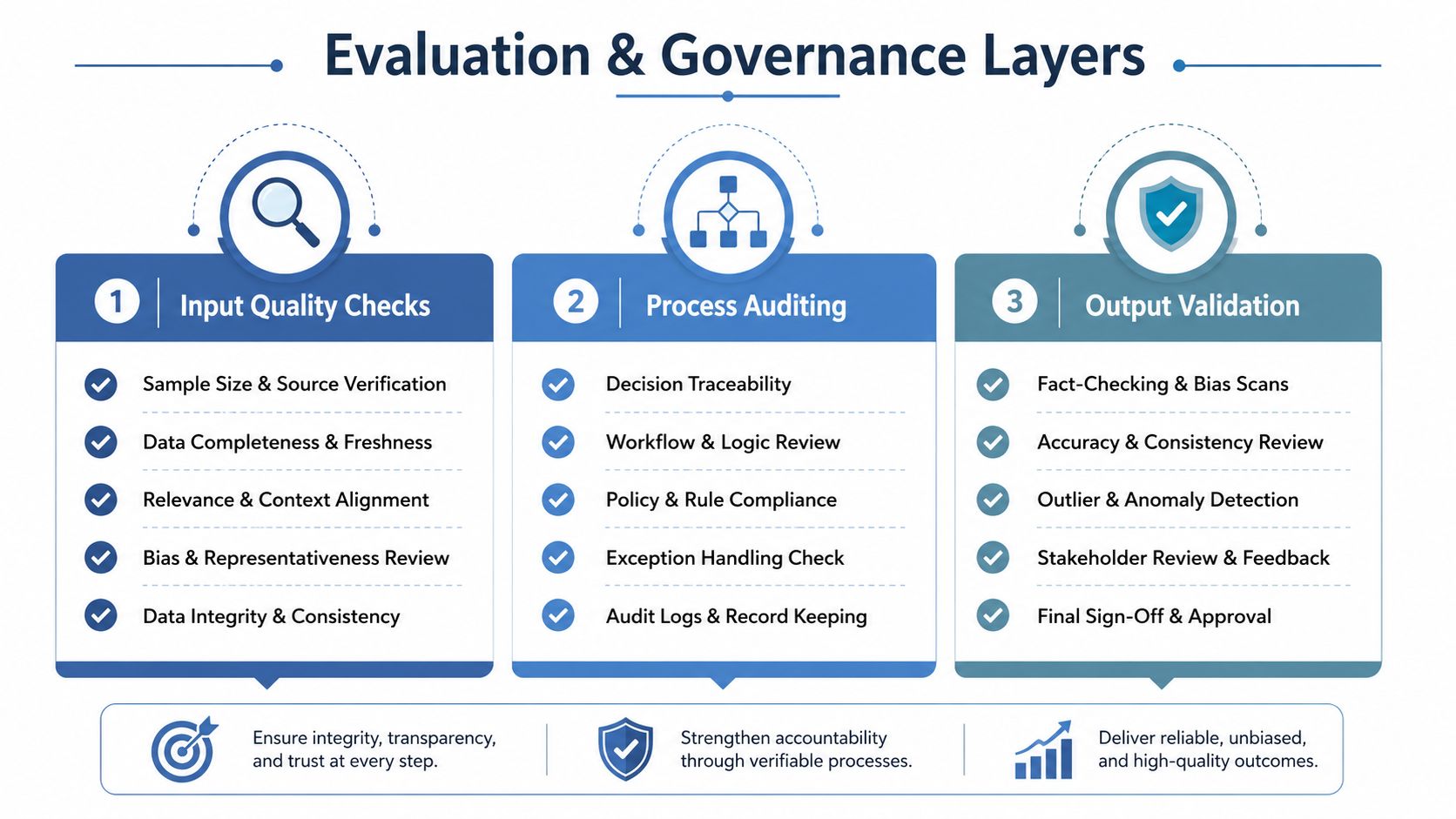
Three layers that make the system defensible
Start with input quality checks. Verify sample size, source provenance, and recency before the agent does any synthesis. That's the easiest way to stop stale data and low-signal inputs from poisoning the result.
Then add process auditing. Every important claim should trace back to a retrieved source, and the system should label claims clearly, including when it's using multiple sources, a single source that needs verification, or no source at all. If the agent can't trace a factual statement, it should refuse to invent it.
Finally, require output validation with human review where judgment matters. A reviewer should check whether the themes answer the brief, whether the evidence is contextual enough, and whether any recommendation overreaches the source material. That's the governance gap many public discussions miss, even while they acknowledge that AI can speed questionnaire design, quota monitoring, narratives, and pattern detection, alongside the need for explicit outcome metrics, documented AI usage, and human review for contextual judgment and governance, as noted in Escalent's coverage of AI agents and market research judgment.
A simple audit log entry looks like this:
Audit log
Research goal, pricing-page objections for mid-market buyers.
Sources used, support tickets, interview transcripts, public reviews.
Confidence, mixed.
Human reviewer, approved after quote traceability check.
Escalation, one unsupported claim removed before the final brief.
The governance point is simple. If the answer can move revenue, the system needs traceability as well as speed. Auditable research wins trust, and trust is what lets you ship faster next time.
Your 30-Day Rollout and What to Ship First
The first month should feel like a revenue project, not an R&D side quest. If you can't point to a faster decision, a cleaner brief, or a better customer signal at the end of 30 days, the stack isn't ready. I'd rather ship a narrow, auditable workflow than a broad demo that nobody trusts.
Week by week, with one real use case in mind
For a B2B SaaS pricing study, week one is the goal brief and source inventory. Decide which segment matters, gather the raw sources, and define the exact pricing decision. Week two is ingestion and retrieval, with the sample cleaned and labeled so the agent can work from evidence.
Week three is the first multi-agent pilot on one segment. Run the Planner, Retriever, Analyst, Writer, and Critic on a narrow slice, then compare the output to the original brief. Week four is governance, audit, and the first decision brief, with unsupported claims removed and the remaining evidence mapped to a pricing recommendation.
A DTC churn interview workflow looks similar, but the emphasis shifts. Instead of proving a pricing threshold, you're trying to surface cancellation reasons, failed expectations, and the language customers use when they're about to leave. That's where the agent can help product, lifecycle, and support teams move in one direction instead of three.
What to measure and what to ignore
Track time-to-insight, cost-per-study, and decision accuracy. Ignore vanity metrics like total outputs or number of themes if they don't change a business decision. The whole point is to compress the path from signal to action.
If you need a Monday-morning plan, keep it tight:
- Inventory sources. Pull in the tickets, notes, transcripts, and reviews that match the decision.
- Write the brief. Name the segment, the deadline, and the evidence format.
- Pilot one segment. Don't generalize too early.
- Add governance. Make traceability and human review essential.
- Write up the result. Show the evidence, the confidence level, and the decision it supports.
If you want one place to start, start with the question that touches revenue fastest. That's usually pricing, churn, or onboarding. Build the agent stack there, prove it, then expand it into a broader customer-intelligence operating system.
If you're ready to turn customer research into a live operating layer, start with one decision this week, one segment, and one auditable source set. Build the brief, run the agent against real evidence, and force every claim to earn its place before it reaches a decision.