
An AI content checker estimates how closely text matches patterns linked to generated writing, using signals such as predictability, sentence variation and style. It cannot prove who wrote something, and scores shift after light editing or a vendor update. I use one as a triage signal that decides what gets a human review, never what gets rejected.
The most popular advice about an AI content checker is wrong. People treat a score as evidence of authorship, then use it to reject a freelancer, challenge a student, or question a contributor. A detector can't prove who wrote a passage. It can only identify patterns that resemble text in its training data.
I run these checks on client content every week. My rule is simple: use the checker as a triage signal, then let a person investigate the context. That approach creates a useful editorial system for a solo operator or a small team. It also prevents a probability score from becoming a false accusation.
Below, I'll show what these tools measure, why their accuracy claims break down, and how to build a workflow you can run this week with a spreadsheet, two detectors, and a human review step.
Table of Contents
- The Uncomfortable Truth About AI Content Checkers
- How AI Content Checkers Actually Read Your Text
- Why Accuracy Numbers Lie to You
- A Monday-Morning Workflow for Running a Check
- When You Should Trust a Score, and When You Shouldn't
- The False Positive That Almost Cost Me a Freelancer
- Shipping a Defensible AI Checker Setup This Week
The Uncomfortable Truth About AI Content Checkers
An AI content checker cannot certify authorship. A 98% human result proves neither that a person wrote the document nor that the writer worked without assistance. A 2% human result cannot establish machine authorship. The tool compares language patterns with patterns associated with generated text. It cannot inspect intent, provenance, or the writer's process.
The category has already received a public warning from one of its most visible creators. OpenAI launched its AI text classifier in January 2023, then shut it down because accuracy was low. By March 2025, Johns Hopkins teaching guidance summarized OpenAI's position that the classifier performed poorly and cited Stanford research on detector bias against non-native English speakers. Johns Hopkins explains the limits of AI detection tools
The score measures patterns, not a writing history
Predictable word choices, regular sentence construction, repeated transitions, and polished prose can trigger a detector. The same traits appear in raw model output, edited human writing, translated text, and technical documentation.
Use the result to sort work for review, then check the failure mode behind it:
- False positives: Human writers, particularly non-native English speakers, may receive AI-like scores.
- Light editing: A small number of revisions can change the statistical shape enough to evade detection.
- Prompt steering: A model can generate more varied prose when instructed to do so.
- Vendor drift: A provider can retrain its model or change its threshold, causing the same passage to receive a different score.
A 2024 peer-reviewed evaluation of 10 free detectors found sensitivity ranging from 0% to 100%. Five tools detected AI-generated content with 100% accuracy in that test, while another scored 0% on AI content. Several produced inconsistent results after paraphrasing or mixing human and machine text. The peer-reviewed detector evaluation is a stronger warning than a product page promising one-click certainty.
My operating rule: Treat a checker like a smoke alarm. Investigate the room it flags, then establish what happened through drafts, writing samples, sentence-level review, and a conversation with the author.
That process takes longer than pressing a red button. It also keeps a weak statistical signal from damaging a freelancer relationship or turning editorial triage into an accusation.
How AI Content Checkers Actually Read Your Text
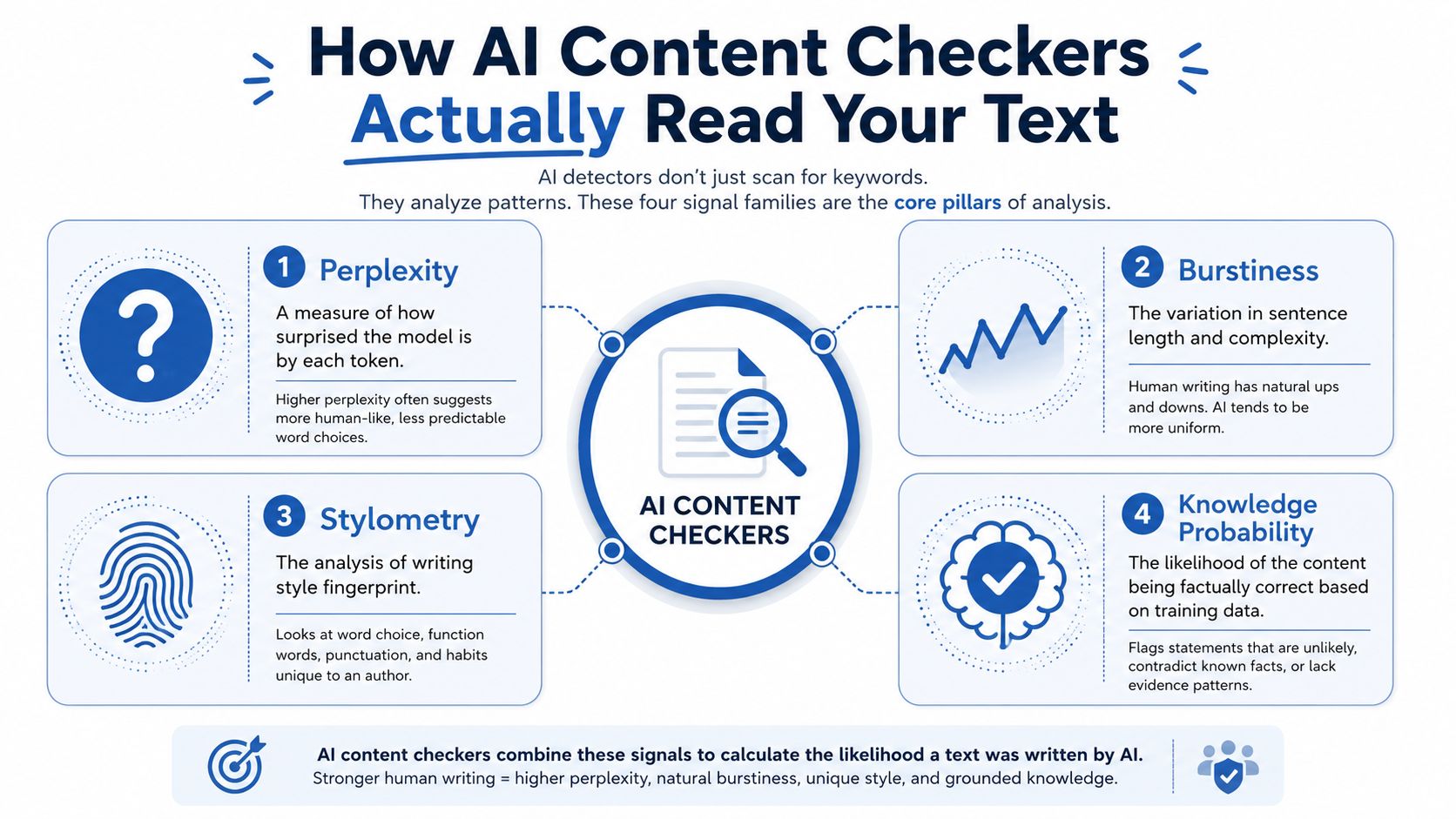
Most detectors combine several signals, though vendors rarely disclose the exact formula. Think of the system as a weather forecast for text. It sees patterns associated with model output and estimates the likelihood that those patterns are present.
The first signal family is perplexity. A language model assigns probabilities to likely next words. If a passage uses highly predictable sequences, the detector may treat it as more model-like. A sentence such as “Artificial intelligence is transforming the future of business” contains familiar phrasing, so a system may find it less surprising than an unusual sentence with personal details and uneven rhythm.
Burstiness measures variation across sentences. Human writers often shift between short and long sentences, while generated drafts may keep a steadier rhythm. A classifier can also examine sentence structure, punctuation, word frequency, and other stylistic features. I group these under stylometric signals, even when a product presents them as separate highlights.
The fourth family is watermark lookup. A model provider can embed a statistical signature into generated text, then use a secret key to test for that signature later. The approach has a serious limitation: the provider holding the key performs the check, so writers and readers can't independently verify the watermark. An explanation of AI watermarking's verification problem treats watermarking as provenance support, not a universal authorship test.
A simple scoring example
Suppose I paste a 150-word product comparison into a checker. The opening sentence is generic and predictable, so it receives an AI-like signal. The next sentence contains a specific customer observation, unusual phrasing, and a sudden change in length, so the signal looks more human. A third sentence uses a polished transition and common marketing language, which pushes the estimate back toward AI.
The tool aggregates sentence-level signals into a document-level probability. It may then highlight the sentences that contributed most to the result. That highlight helps me edit for voice or investigate a draft. It doesn't function like a fingerprint match.
For a practical distinction between the instructions you give a model and the context you supply around those instructions, I use this guide to compare context engineering with prompt engineering. The distinction matters because better context can produce more specific writing, yet specificity alone doesn't prove who typed the final words.
Why Accuracy Numbers Lie to You
Accuracy claims answer a narrower question than buyers expect. A detector can perform well on raw output from a familiar model, then struggle with edited copy, another subject, or prose that resembles its human training examples. Treat the score as a triage signal inside a human-led editorial workflow, not as authorship proof.
The evaluation figures show why vendor badges need scrutiny. Sensitivity across 10 free detectors ranged from 0% to 100%. In another university comparison, one detector reached 99% accuracy on human-written text, while another classified completely human-written text as 100% AI. Those results can coexist because the tools, samples, thresholds, and definitions of success differ. The underlying comparison and study details matter more than a single headline.
Four reasons a headline score collapses
Domain drift causes the first failure. Academic essays, product descriptions, legal explanations, and personal newsletters follow different conventions. A detector calibrated on one kind of prose may flag another because its style falls outside the expected pattern.
Training overlap creates another. If a tool has encountered similar language during development, it may classify familiar human phrasing with confidence without establishing who wrote it.
Paraphrase evasion exposes a third weakness. UCLA summarized research in which detectors identified ChatGPT text with 74% accuracy, but performance fell to 42% after students made small changes. The same summary reported that only 26% of AI-written text was correctly identified in another result, while 9% of human writing was falsely flagged. UCLA's summary of detector limitations explains why cleanup tools and modest edits make every score harder to interpret.
False positives create the fourth risk. Non-native English writing, translations, formal explanations, and heavily edited drafts can share the regular patterns associated with generated text. A high score may describe surface style rather than misconduct.
| Claim | Reality | Failure Trigger |
|---|---|---|
| “High accuracy” means reliable authorship proof | It describes performance on a defined test set | Your content differs from that set |
| A sentence highlight identifies machine writing | It marks a statistical pattern | Polished or generic human prose |
| A low score means the draft is safe | It may miss edited or paraphrased output | Light rewriting or model variation |
| One tool settles the question | Detectors disagree on the same material | Different thresholds and model lineages |
Test a checker against your own workflow before paying for a seat. I run 20 labeled samples, including known human drafts and known model-assisted drafts, then record content type, length, author, score, and final human judgment. This exposes domain drift and false positives in your actual material. It also shows whether paraphrased drafts evade the tool.
My rule is simple: a score can decide what deserves review, never what deserves rejection.
A Monday-Morning Workflow for Running a Check
I run the check before editing, not after. The raw draft preserves the signal I'm trying to inspect. Heavy human rewriting can lower the score without changing the underlying authorship question, which makes a post-edit result hard to interpret.
Here's the routine I'd put in place for a solo publisher or a small editorial team.
Run the check before anyone polishes the draft
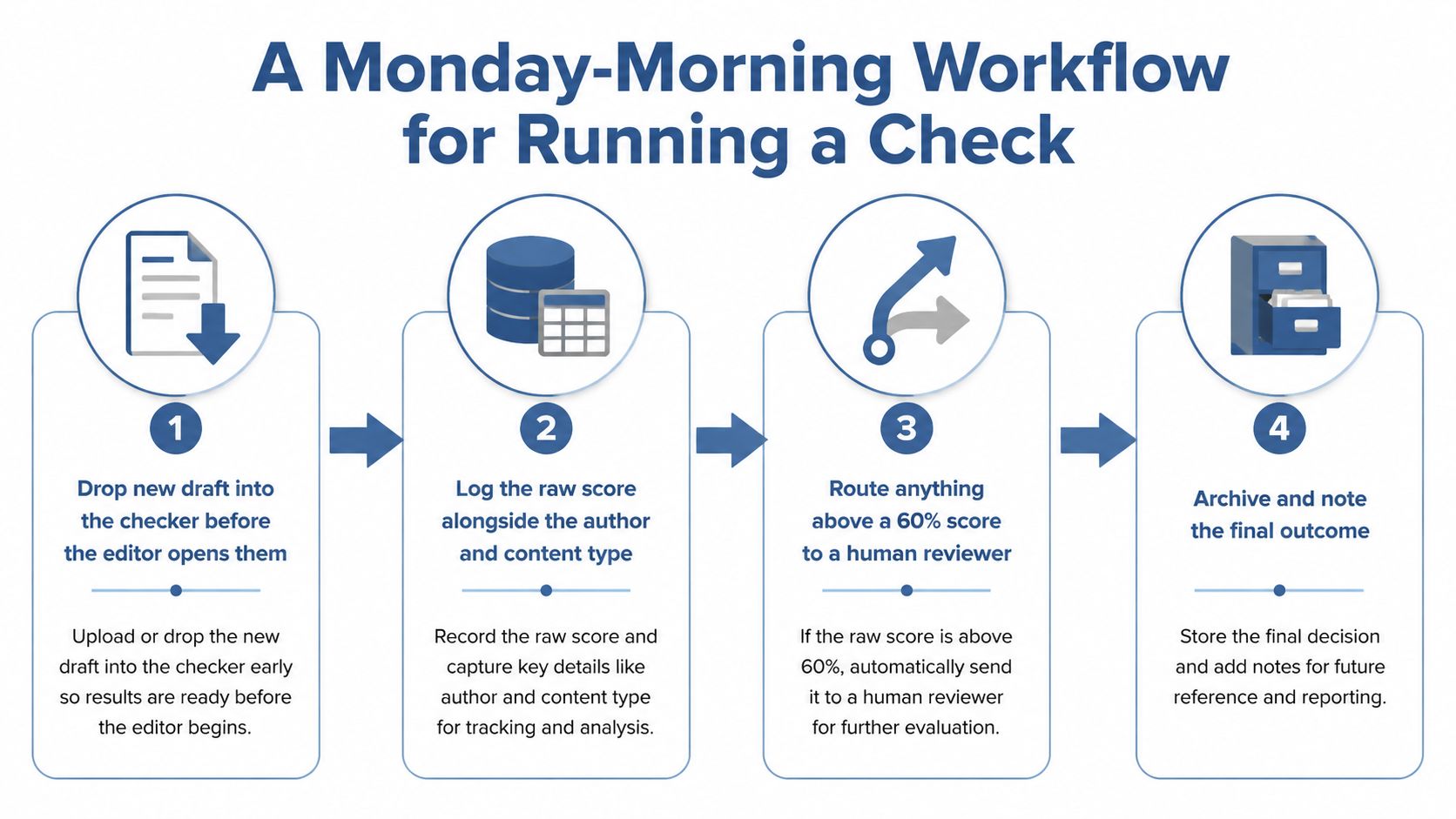
On Monday morning, I collect the new drafts in one folder or Notion database. I paste each piece into the checker before the editor opens it, then log four fields: author, content type, raw score, and date.
I use the following routing rule:
- Under 30% AI likelihood: Pass the draft into normal editorial review.
- 30% to 60%: Compare the style against the author's previous pieces.
- Above 60%: Start a conversation and request a human review. Do not reject the draft automatically.
The score bands are workflow thresholds, not scientific facts. They help me decide where to spend attention. They don't convert probability into proof.
Ask the reviewer three diagnostic questions
For every flagged draft, I ask:
- Which exact sentences triggered the score, and do they contain generic phrasing or specific evidence?
- Does the author's earlier work use a similar rhythm, vocabulary, and level of polish?
- Can the author provide notes, sources, outlines, version history, or a short explanation of how the piece was produced?
I check batches small enough to review properly. If the queue grows beyond what I can inspect on Monday, I reduce the intake rather than letting the score become an automatic gate. The point is to surface work that needs attention, not to create a second screening system I can't maintain.
I archive the final outcome beside the original result: cleared, revised for voice, discussed with author, or rejected for a separate editorial reason. Within a month, the log should show whether the tool catches useful patterns or targets formal writing.
For the model choice behind a workflow, I keep a separate reference on which LLM is the best. The checker belongs after drafting and before editorial polish, where it can inform a decision without pretending to replace one.
When You Should Trust a Score, and When You Shouldn't
A single score deserves limited trust. I get more value by running two detectors on the same passage and comparing the spread, then checking the result against the author's baseline and the document's context.
If both tools flag the same passage and the writing departs sharply from the author's previous work, I investigate. I still don't call the author dishonest. Consensus makes a review more useful. It doesn't create certainty.
Context decides how much weight the number gets
Short, generic copy can produce a readable signal because it contains fewer ideas and often relies on familiar phrasing. Recycled boilerplate can also deserve attention when it appears across multiple pages. Voice consistency matters for brand publishing, so a score can point me toward sentences that need a rewrite even when authorship isn't the concern.
The signal gets weaker in technical tutorials, translated material, heavily edited drafts, and text that resembles material a model may have seen during training. Those documents contain legitimate reasons for predictable language. Treating them as high-confidence detection zones is poor judgment.
| Content Scenario | Score Reliability | Recommended Action |
|---|---|---|
| Short generic website copy | Moderate | Inspect highlighted sentences and revise for specificity |
| Reused boilerplate | Moderate | Compare against approved source text |
| Technical tutorial | Risky | Review sources, drafts, and author explanation |
| Translated writing | Risky | Avoid authorship conclusions from the score |
| Heavily edited draft | Low | Compare the original version before deciding |
| Voice-critical publication | Useful for triage | Use a style baseline and human approval |
A university guide says there is no fool-proof technological solution. It also cites a January 2025 study where detectors returned different scores for the exact same files, while one journal-submission study reported AI detection of about 63% and false positives around 24.5% to 25%. The Illinois State guidance on detector limits is the standard I follow when someone asks whether a percentage can settle a dispute.
I also avoid publishing an “X% AI” badge beside a writer's work. If you're building trust into an AI-assisted workflow, the PlotStudio AI trust framework is useful context for thinking about transparency without turning an uncertain classifier into a public label.
The False Positive That Almost Cost Me a Freelancer
A seasoned freelancer once sent me a technical tutorial that scored 72% AI. I initially assumed the draft had been generated and lightly cleaned, because the prose was unusually smooth and the checker had highlighted several complete paragraphs.
The writer pushed back immediately. They shared the messy first draft, source notes, revision history, and the version where they had restructured the explanation. The published-looking version wasn't machine-written. The writer had done the exact work I normally ask for, removing repetition, tightening transitions, and making a difficult tutorial easier to follow.
The edit changed the statistical shape
The first draft had uneven sentences, abandoned explanations, and awkward transitions. The revised version had consistent paragraph lengths, direct topic sentences, and cleaner connective language. Those improvements also moved the text toward the patterns the checker had learned to associate with generated prose.
That incident changed my process. I had run the check after the most substantial human editing, so I had erased the comparison point that could have explained the result.
The problem isn't limited to one provider. A detector can punish clean prose because clean prose often looks regular.
The rule I use now: Never confront an author with a score alone. Show the flagged passage, inspect the earlier draft, and ask for process evidence before you form a conclusion.
I also never run the final check after heavy rewriting. If I want a detection signal, I save the original submission and scan that version first. Later editorial checks serve a different purpose, voice and quality, so I label them accordingly.
The freelancer kept the assignment. I kept a record of the failure. That record now protects contributors whose writing improves during editing, which is exactly the group a crude score can misread.
Shipping a Defensible AI Checker Setup This Week
You can build a workable system in five days without a dedicated department. I'd use two detectors, a Google Sheet or Notion database, and either Zapier or n8n for the handoff. Automation should move drafts and alerts. It shouldn't make the accusation.
Day 1 defines the terms
Write a one-page policy that separates AI-assisted from AI-generated. AI-assisted might include brainstorming, outlining, transcription, or research organization. AI-generated means a model produced substantive prose that a person didn't materially rewrite.
Set the response for each category. You may permit assistance with disclosure, require a human rewrite, or reject generated copy for a particular publication. The policy needs to tell a freelancer what to disclose before the first assignment.
Day 2 creates a local baseline
Choose two checkers with different model lineages. Run 20 known-author samples through both tools, then record the scores beside the author, content type, and document length. Keep the samples representative of what you publish, not generic text copied from a vendor page.
If the tools disagree on your own examples, that disagreement becomes part of your operating policy. You can still use the checkers for triage, but you shouldn't present either output as a reliable verdict.
Day 3 connects the draft status to the checks
Create a Notion or Google Docs status called “Ready for AI check.” A Zapier or n8n flow can send the draft to the selected tools, write the raw results into your log, and attach the document to a review queue.
Don't automate rejection. Send a Slack alert when a score exceeds 60% AI probability, then name a human reviewer in the alert. The reviewer examines the original draft, highlighted text, author history, and supporting notes.
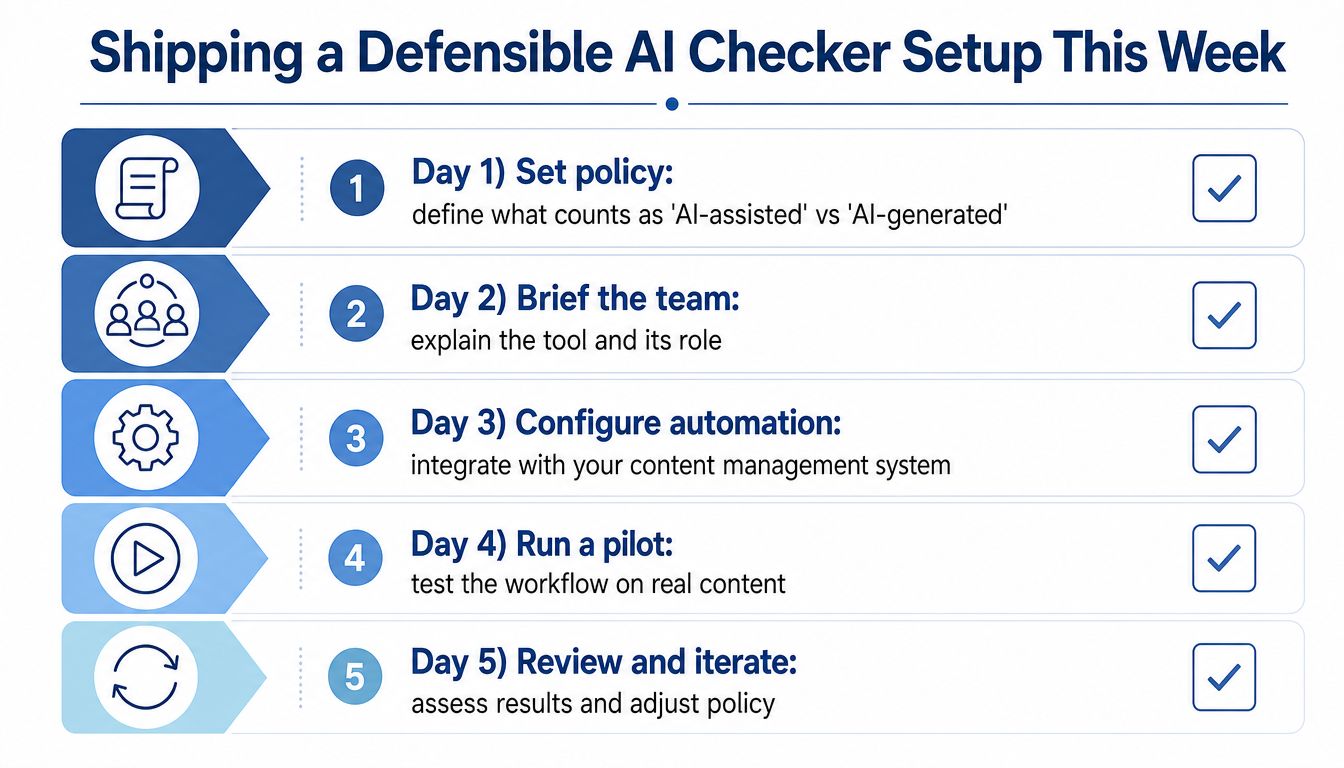
Day 4 pilots the process on real work
Run the flow on a small batch of current drafts. Check whether the alerts arrive with enough context to make a decision. If you need to open three systems before you can see the original text, author, and score, fix that before expanding the process.
I'd also review the data handling terms for every provider. Client drafts, freelancer submissions, and unpublished product information shouldn't enter a service unless you understand how the service stores and uses them.
Day 5 documents the decision trail
Publish the policy, the reviewer questions, and the escalation path. Add a freelancer agreement covering disclosure rules and explaining that a detector result leads to human review rather than automatic rejection.
Legal and platform requirements deserve a separate check. Review applicable FTC guidance on AI disclosures, plus the current rules and documentation for Google, Meta, and Amazon before you publish claims or endorsements involving AI. If you accuse a writer without a human-reviewed investigation, you create contractual and reputational risk that no score can justify.
For owners building agent workflows, what is Model Context Protocol provides useful background on how tools and context can connect. Keep the architecture small enough to inspect yourself.
The final rule is the one that keeps the whole setup honest: a checker score is a triage signal, never a verdict, and every escalation needs a named human reviewer in the audit log.
If you publish content this week, create the log before you buy another detector. Record the author, content type, original score, highlighted passage, reviewer, and final decision. Then run your next batch before editing and use the results to decide whether the tool helps your workflow or merely creates noise.
If you want the weekly version of this kind of practical AI workflow, read Bionic Business and apply one small system to your own business this week.
Frequently Asked Questions
Can an AI content checker prove who wrote a text?
No. A checker compares language patterns with patterns associated with generated text. It cannot inspect intent, provenance or the writer’s process, so a 98% human result proves nothing about authorship and a 2% human result cannot establish machine authorship. OpenAI launched its own AI text classifier in January 2023 and later shut it down because accuracy was low.
How accurate are AI content checkers?
Accuracy varies widely. A 2024 peer-reviewed evaluation of 10 free detectors found sensitivity ranging from 0% to 100%. UCLA summarized research where detection of ChatGPT text fell from 74% to 42% after small edits, with 9% of human writing falsely flagged. One journal-submission study reported about 63% detection and false positives around 25%, and detectors have returned different scores for identical files.
Why do AI detectors flag human writing as AI?
Detectors treat regular, predictable prose as model-like, so clean writing can look machine-made. Non-native English writing, translations, formal explanations, technical tutorials and heavily edited drafts all share the regular patterns associated with generated text. A high score may describe surface style rather than misconduct, which is why careful editing can push a genuinely human draft toward an AI-like result.
How do AI content checkers work?
Most combine several signals. Perplexity measures how predictable the word choices are. Burstiness measures how much sentence length and rhythm vary. Stylometric features cover structure, punctuation and word frequency. Some providers also embed a watermark in generated text, but only the provider holding the secret key can check it. The tool then aggregates sentence-level signals into a document-level probability.
What should you do when a draft gets a high AI score?
Do not reject it automatically. Look at the exact sentences that triggered the score, compare the draft with the author’s earlier work, and ask for notes, sources, outlines or version history. Run the check on the original submission before editing, because heavy rewriting changes the statistical shape. Never confront an author with a score alone.
Should you use more than one AI detector?
Yes. Run two checkers with different model lineages on the same passage and compare the spread. Before paying for a seat, test them on known-author samples from your own content and record the scores beside author, content type and length. If the tools disagree on your own examples, treat both as triage signals and never present either output as a verdict.