
The neuromarketing strategies that convert treat each brain-based principle as a hypothesis you test. I work with four levers: attention, emotion, memory and decision. Find the weakest one on your page, change only that element, measure it against a baseline with heatmaps and short recall surveys, and let completed conversions decide what stays.
Neuromarketing advice usually starts with a trick, a color, a countdown, or a claim about the “buy button” in the brain. That's the wrong place to start. A tactic can attract attention and still lose the sale, damage trust, or produce a lift that disappears as soon as visitors recognize the pattern.
I'm Samuel Woods, and I treat neuromarketing strategies as testable design decisions. AI creates opportunities here because it can turn raw session data, survey responses, and creative variants into a weekly testing workflow. You still need judgment, clean instrumentation, and restraint. The machine can draft ten emotional headlines in seconds. It can't tell you whether your promise is honest.
Table of Contents
- Why Neuromarketing Strategies Stop Working the Day You Publish Them
- The Four Brain Levers Every Neuromarketing Strategy Turns
- Measuring Attention and Emotion Without a Lab
- Which Neuromarketing Strategy to Test First
- A One-Week SOP for a Neuromarketing CRO Experiment
- Where These Strategies Break and What I Got Wrong
- Your Monday Morning Neuromarketing Checklist
Why Neuromarketing Strategies Stop Working the Day You Publish Them
The popular assumption is that neuromarketing requires an EEG headset, an fMRI scanner, or a research lab. Those tools are real. Neuromarketing research uses non-invasive methods including fMRI, EEG, MEG, TMS, and eye-tracking to examine attention, emotion, memory, and decisions in response to marketing stimuli (Taylor & Francis).
Most solo operators don't need that setup to improve a landing page this week. They need a measurable hypothesis about what draws attention, what creates an emotional response, what people remember, and what makes the next action easier.
The page has to be instrumented first
A contrast change, a sharper pain statement, or a simpler pricing choice can reflect neuromarketing principles. It becomes a useful strategy only when you can compare the result with a baseline.
That means tracking the event that matters. A button click can be useful for diagnosing attention, but a completed checkout, qualified lead, or retained customer tells you more about business value. If you add a bright CTA without recording downstream behavior, you've created decoration, not evidence.
Neuromarketing became a named field in 2002, when Dutch marketing professor Ale Smidts described it as the study of cerebral mechanisms used to understand consumer behavior and improve marketing strategies (bibliometric review). The shift mattered because researchers could study physiological and neurological responses alongside what consumers said.
That history also explains the common mistake. People borrow the vocabulary of neuroscience while skipping the research discipline. They paste “loss aversion” into a headline, add urgency to a button, and declare success after a short burst of clicks.
Practical rule: Treat every brain-based principle as a hypothesis, never as a guaranteed conversion formula.
Where AI earns its place
AI is useful after you collect context. I can feed an agent the page copy, analytics events, session-replay notes, customer language, and one selected cognitive lever. It can produce variants, group recurring objections, and flag copy that makes unsupported psychological claims.
It can't replace a clean experiment. It can't rescue a page with a vague offer. It can't prove that attention became preference.
The opportunity now exists because a solo operator can connect analytics, lightweight research, and an LLM without building a research department. The workflow I'd build this week is simple: establish a baseline, choose one lever, draft controlled variants, run the test, and record what failed.
The Four Brain Levers Every Neuromarketing Strategy Turns
Neuromarketing is not a conversion formula. It is a practical audit for finding where a page loses attention, meaning, recall, or decision clarity. Research repeatedly groups these variables together because they reflect how people process advertising and offers (2021 bibliometric analysis). I use the four levers to define testable changes, then connect them to analytics and AI so a solo operator can run controlled experiments instead of collecting neuroscience jargon.

Attention
Attention asks whether visitors notice the information required to continue.
Set a clear visual hierarchy. A Z-pattern can fit a sparse page, while an F-pattern often fits text-heavy pages. Put one meaningful contrast point near the first decision, such as a product image, specific outcome, or CTA. Motion can separate a cue from surrounding content, but movement that competes with the headline becomes interference.
For a service page, test “Automate weekly customer reporting” against “Save time with smarter reporting.” The first gives attention a concrete object. Track hero-to-next-section clicks and completed form starts, then check whether lead quality changes rather than judging the winner on clicks alone.
For visual creative, the Veo3 AI platform can produce controlled video variants. Keep the voiceover, offer, and duration stable while changing one visual attention cue. AI makes the production loop faster, but it does not decide which cue deserves the test.
Emotion
Emotion gives information meaning. A gain-framed headline can promise progress, while a loss-framed version can name the cost of staying stuck. Neither framing wins automatically, so connect the wording to the buyer's actual problem.
Write that problem in plain language. “Your weekly report still takes three hours” carries more emotional information than “Improve reporting efficiency.” Match the image to the promise. A worried face beside a calm productivity claim creates confusion; a product-in-use image can make the outcome easier to feel.
Track scroll depth, CTA clicks, and post-click completion. If an emotional version earns attention but weakens trust at the next step, improve the proof bridge before increasing emotional intensity.
Memory
People retain structures and repeated cues more readily than disconnected claims. Group related features, repeat the central promise across the hero, subhead, and CTA, and carry one distinctive brand cue through the page.
A landing page can introduce the promise in the hero, explain it through one short customer scenario, and restate the same outcome at the CTA. Use consistent language for that repetition, not three clever synonyms. For video or motion work, produce multiple executions while preserving the same memory cue in every cut.
Track unaided recall in a short follow-up or intercept. You can also ask visitors to write three words describing the offer after exposure. The result gives you a usable signal for message retention, not proof that memory caused a purchase.
Decision
Decision design removes avoidable mental work. Reduce competing CTAs, explain the next step, and make the pricing frame easy to compare.
Pricing research examines charm pricing, anchoring, and reference-price framing as methods that shape perceived affordability and attractiveness by reducing deliberative processing (Frontiers pricing research). Test a single recommended plan against equal-weighted options. Track plan selection, checkout completion, refunds, and support questions. A higher click rate means little if buyers choose the wrong plan and cancel.
For a practical framing reference, keep notes on behavioral economics in marketing strategy beside the page brief. The useful question stays concrete: which decision did the design make clearer? Record that question in the experiment brief, then use analytics and AI-generated variants to test one lever at a time.
Measuring Attention and Emotion Without a Lab
You can build a lightweight measurement stack without claiming that a webcam gaze estimate equals EEG. That distinction matters. Eye-tracking provides spatial attention data, while EEG provides temporal sensitivity, and research reviews recommend complementary measures because one signal can't explain attention, interpretation, emotion, and choice alone (systematic review).
Start with the page or ad you already have. Run a predictive attention test through Attention Insight or Visualeyes, then use RealEye or GazeRecorder when you need webcam-based gaze proxies. These tools can reveal whether the headline, image, or CTA is likely to receive attention. Treat the output as directional evidence.
A practical weekly stack
Use PickFu or UserTesting for fast emotional feedback. Show the creative briefly, ask what participants felt, and collect language rather than accepting a single “liked it” score. Your minimum survey can include an implicit association prompt, a three-word recall task, and a willingness-to-pay slider.
Connect the behavioral layer in GA4 or Plausible. Use PostHog session replays to inspect confusion, rage clicks, and exits. Then place attention proxy score, recall rate, emotional valence, and conversion rate in a simple Looker Studio view.
| Tool Category | Example Tool | Cognitive Signal | Weekly Cost |
|---|---|---|---|
| Predictive attention | Attention Insight or Visualeyes | Likely visual allocation | Qualitative, based on plan |
| Webcam gaze proxy | RealEye or GazeRecorder | Approximate fixation pattern | Qualitative, based on plan |
| User feedback | PickFu or UserTesting | Emotional reaction and language | Qualitative, based on plan |
| Product analytics | GA4 or Plausible | Clicks, steps, conversion | Qualitative, based on plan |
| Session replay | PostHog | Confusion and interaction behavior | Qualitative, based on plan |
The number that matters depends on the question. For visual design, watch the attention proxy alongside CTA visibility. For messaging, watch recall rate. For the business, keep completed conversion as the final check.
I'd also keep a separate customer sentiment analysis tools guide open when sorting free-text responses. Sentiment labels are useful for grouping language, but they shouldn't replace reading the actual comments.
Which Neuromarketing Strategy to Test First
The best first test sits closest to revenue and has a clear failure condition. I wouldn't begin with a cinematic emotional campaign if the pricing page leaves buyers uncertain about what they receive.
| Tactic | Implementation Effort | Brand Risk |
|---|---|---|
| Specificity-rich social proof | Low | Low if evidence is real |
| Calibrated scarcity | Low | High if artificial |
| Neuro-pricing | Medium | Medium |
| Sensory micro-cues | Low | Medium |
| Loss-framed CTA | Low | Medium |
I haven't put a sample size or lift range on these rows. Your baseline conversion rate, traffic source, audience mix, and test duration determine whether a result is useful. Use a sample-size calculator before launch and set the minimum detectable effect in advance.
Pick by funnel stage
On a homepage, start with attention or emotional clarity. On a pricing page, test anchoring, plan framing, or the cost of delay. At checkout, remove friction before adding persuasion.
Specific social proof should name the situation it proves. “Used by thousands” is weaker than a verified statement that describes the customer, use case, and outcome. The anti-pattern is invented or vague proof.
Scarcity should describe a real limit, such as a fixed intake window or finite inventory. A countdown that resets trains visitors to distrust every future deadline.
Neuro-pricing can test a reference price or charm format, but don't hide fees. Sensory cues can improve hierarchy through contrast or motion, but don't use motion near payment fields. Loss-framed CTAs can clarify what delay costs, but fear-heavy copy can make a considered purchase feel coercive.
When traffic is below 5,000 sessions per week, test the lever closest to revenue first. When traffic is higher, test the lever closest to the top of the funnel. That sequencing keeps a small audience from spending weeks on a subtle hero adjustment while the checkout remains broken.
A One-Week SOP for a Neuromarketing CRO Experiment
This is the workflow I'd run alone. It replaces scattered copy edits, untracked opinions, and the temptation to change five page elements at once.
Days one and two create the test
Day 1: Choose one lever and write this hypothesis:
Changing [element] from [A] to [B] will increase [metric] because [cognitive principle].
Use one primary metric. If you're testing a CTA, choose completed form submissions or purchases rather than collecting every available click.
Day 2: Give your brand voice document, audience segment, existing copy, offer details, and selected lever to an AI agent. Use this prompt:
You are a conversion copy editor working under strict evidence and brand-safety rules.
Brand voice: [PASTE BRAND VOICE]
Audience segment: [PASTE AUDIENCE SEGMENT]
Offer: [DESCRIBE OFFER]
Page element being tested: [PASTE ELEMENT]
Control version: [PASTE CONTROL COPY]
Neuromarketing lever: [ATTENTION, EMOTION, MEMORY, OR DECISION]
Primary metric: [PASTE METRIC]Produce three variant copy blocks, three headline options, and two CTA phrasings. Change only the selected lever. Keep the offer, factual claims, audience, and reading level consistent. Do not invent testimonials, numbers, urgency, scarcity, guarantees, clinical claims, or customer outcomes. For every variant, explain which words changed and why they express the selected lever. Flag any variant that could feel manipulative or require proof I haven't provided. Return the work in a table with columns for Variant, Copy, Cognitive Rationale, Required Evidence, and Risk.
This prompt gives the model boundaries. Without them, it will often add fake urgency or unsupported proof.
Days three through seven protect the evidence
Day 3: Reject any variant that violates your voice, claims more than your evidence supports, or changes multiple levers. Keep one control and one challenger if traffic is limited.
Day 4: Configure the A/B test in your existing tool. Set the minimum detectable effect at 5%, preregister the success metric, and record the audience and exclusion rules.
Day 5: Test the page on desktop and mobile. Check analytics events, payment flow, accessibility, loading behavior, and the exact copy shown in each variant.
Day 6: Launch and monitor instrumentation bugs, not results. If events fire twice or the variant assignment fails, stop and repair the test.
Day 7: Read directional data only, then queue the next hypothesis. Don't turn an early signal into a permanent rule.
I keep the broader conversion rate improvement workflow nearby when deciding whether a winning copy change belongs in the product experience or only in the experiment queue.
Where These Strategies Break and What I Got Wrong
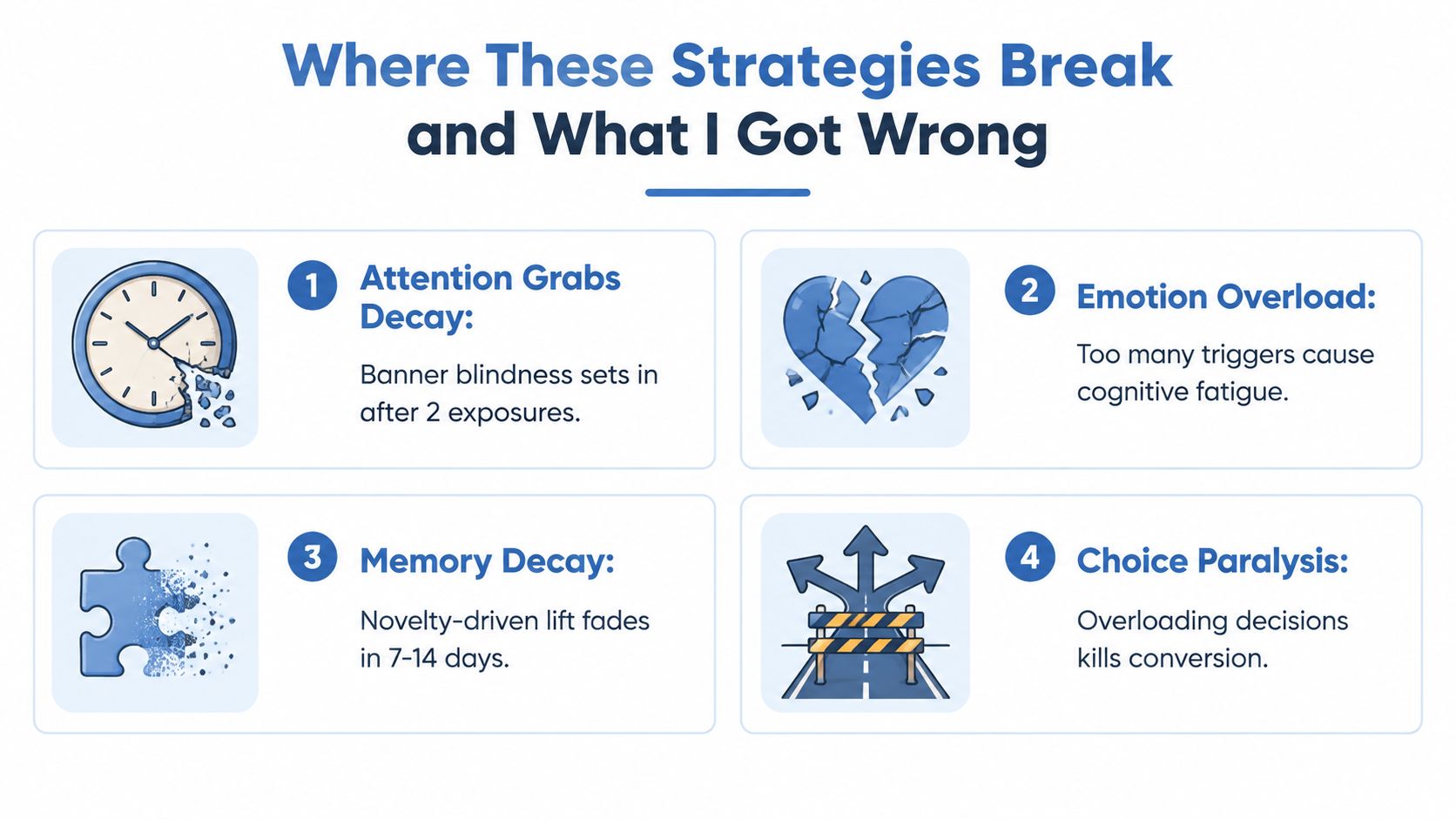
Neuromarketing tactics fail when the operator mistakes a short-term response for a durable preference. The literature itself describes the field as methods-led, with fMRI, EEG, and eye-tracking used at different rates across research contributions, while reviews continue to call for better standardization and careful control of confounds (comprehensive review).
The response can decay
Attention grabs lose force as visitors become familiar with them. An animated hero may earn an initial response, then become background noise. I'd never promote a novelty treatment without checking whether the effect survives repeated exposure.
Emotion has a different failure mode. A fear-heavy first visit can convert while weakening the customer relationship if the product experience feels ordinary or disappointing. A short conversion dashboard won't necessarily reveal that loyalty gap.
Scarcity is even less forgiving. A fake deadline teaches the buyer that your deadlines aren't real. Once trust drops, later offers need more proof to earn the same consideration.
The page can contradict itself
A strong contrast cue may increase sign-ups while making a pricing page feel aggressive. A bright badge beside a high price can draw the eye to the exact objection you hoped to hide.
I used to optimize the first click too quickly. The better sequence is to compare attention, emotional response, recall, completed conversion, refunds, and repeat behavior where the business model allows it. The field's recent commercial momentum doesn't make every signal predictive. One review estimated the global neuromarketing market at about USD 1.44 billion in 2023, with a projection of roughly USD 3.11 billion by 2032, while another paper estimated USD 25.91 billion in 2024 and USD 45.3 billion by 2035. The gap between estimates shows why market enthusiasm isn't a substitute for measurement (market review).
Before scaling a tactic, ask:
- Did the change improve the business metric or only an attention proxy?
- Does the message remain truthful after repeated exposure?
- What happens to trust, retention, refunds, or support volume after the initial response?
Your Monday Morning Neuromarketing Checklist
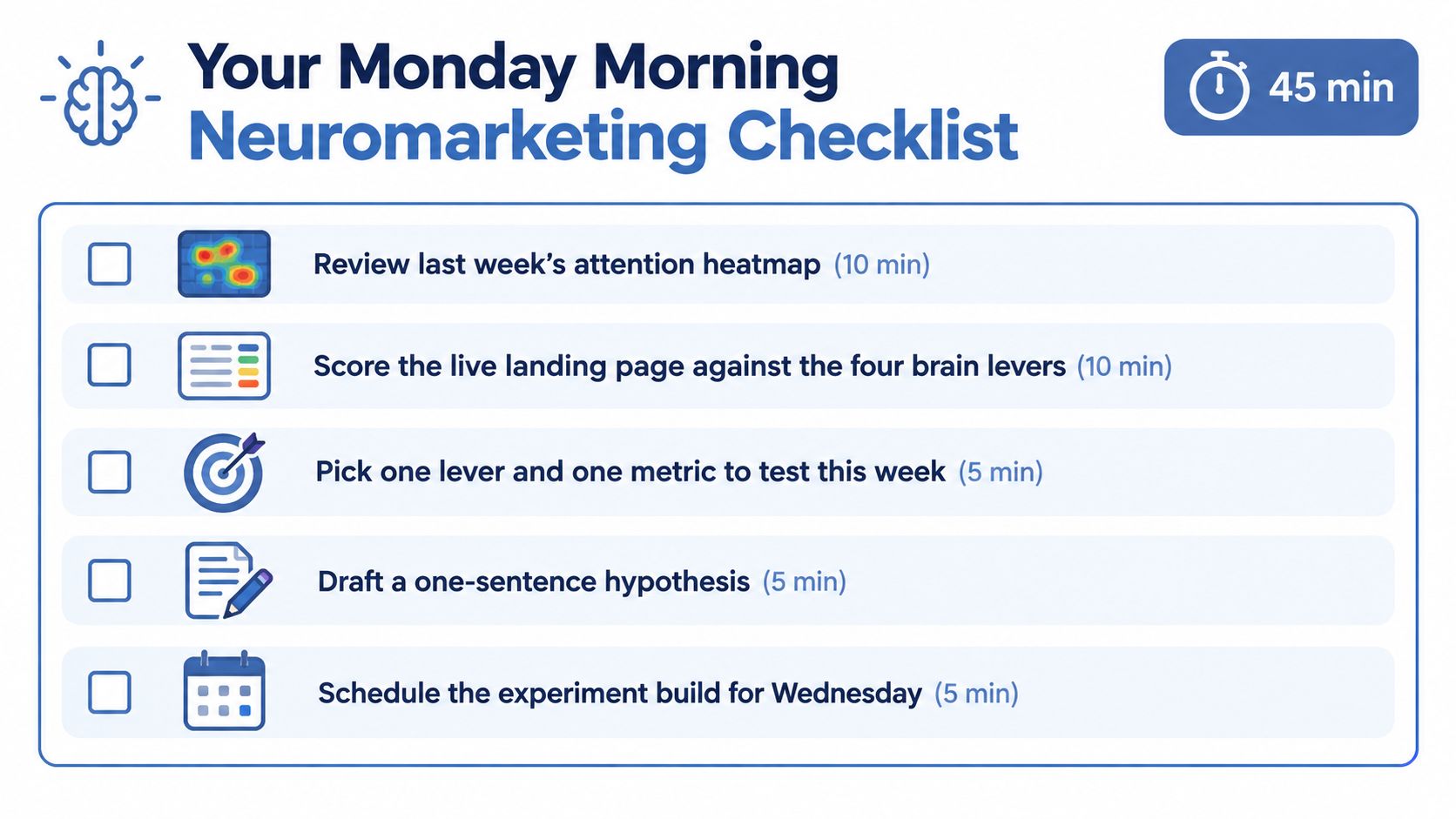
Run this ritual in 45 minutes. The goal is not a lab-grade neurostudy. It is a repeatable learning loop that turns attention and emotion signals into a test you can ship.
The printable version
- Review attention, 10 minutes: Open Hotjar or Microsoft Clarity. Check the previous week's heatmap, scroll behavior, and hesitation points. Without biometrics, these tools provide a practical attention layer.
- Score the page, 10 minutes: Rate attention, emotion, memory, and decision on the live page. Write one sentence identifying the weakest lever.
- Choose one test, 5 minutes: Use the lever table above. Select one lever and one primary metric. Keep a new headline, pricing frame, and CTA out of the same challenger.
- Draft variants, 10 minutes: Give the AI agent the current page, audience context, and brand voice. Request two viable variants, then remove claims or language the evidence cannot support.
- Schedule the build, 5 minutes: Put the experiment build on Wednesday's calendar. Reserve Thursday for emotion and sentiment review, with a later checkpoint for recall sampling.
Use GA4 or Plausible for conversion performance. Use Maze for recall tasks when a page or prototype needs memory validation. PickFu or UserTesting can expose the emotional language people use around a variant. Treat sentiment as context, not a verdict.
The preregistered metric decides whether the next cycle earns attention. For a page test, that may be completed checkout or qualified lead submission. Attention, recall, and emotional valence help explain the result. They do not replace the business outcome.
Keep a small experiment archive. Record the date, hypothesis, control, challenger, audience, primary metric, result, and next test. Log losses as carefully as wins. After several cycles, the archive shows which messages customers understand, remember, and trust.
AI speeds up hypothesis creation and sorting. It does not decide whether a test is valid. On Monday, open the heatmap, select one lever, write one hypothesis, and schedule the build before maintenance work takes over.
If you want the full weekly system for turning AI opportunities into practical workflows, read the ongoing work in Bionic Business, where I document what I build, what breaks, and the numbers I use to decide what stays.
Frequently Asked Questions
What are the four levers of neuromarketing?
Attention, emotion, memory and decision. Attention asks whether visitors notice what they need to continue. Emotion gives information meaning, for example through gain-framed or loss-framed headlines tied to a real problem. Memory depends on structure and repetition, so repeat the central promise in the same words. Decision design removes avoidable mental work by cutting competing CTAs and making pricing easy to compare.
Can you do neuromarketing without an EEG or eye-tracking lab?
Yes, as long as you treat the output as directional. Run predictive attention tests in Attention Insight or Visualeyes, use RealEye or GazeRecorder for webcam gaze proxies, and gather emotional reactions through PickFu or UserTesting. Connect GA4 or Plausible for conversions and PostHog session replays for confusion and exits. A webcam gaze estimate is not equivalent to EEG, so keep completed conversion as the final check.
Which neuromarketing tactic should I test first?
Start with the lever closest to revenue that has a clear failure condition. On a homepage, test attention or emotional clarity. On a pricing page, test anchoring, plan framing or the cost of delay. At checkout, remove friction before adding persuasion. When traffic is below 5,000 sessions per week, test near revenue first so a small audience isn’t spent on subtle hero changes.
Do scarcity and urgency tactics still work?
Only when the limit is real, such as a fixed intake window or finite inventory. A countdown that resets trains visitors to distrust every future deadline, and once trust drops, later offers need more proof to earn the same consideration. Fear-heavy copy can also convert a first visit while weakening the customer relationship, so watch refunds and retention as well as the initial conversion.
How do you run a neuromarketing A/B test in one week?
Day 1, choose one lever and write a hypothesis. Day 2, have an AI agent draft variants that change only that lever. Day 3, reject variants that break your voice or overclaim. Day 4, configure the test and preregister the metric. Day 5, check desktop, mobile and analytics events. Day 6, launch and watch for instrumentation bugs. Day 7, read directional data and queue the next hypothesis.
Why do neuromarketing tactics stop working over time?
Attention grabs lose force as visitors get used to them, so an animated hero can fade into background noise. Short-term responses can also hide damage: a strong contrast cue may lift sign-ups while making a pricing page feel aggressive. Before scaling a tactic, check that it improved the business metric, stays truthful after repeated exposure, and didn’t hurt trust, retention, refunds or support volume.