
Most advice on the ai agent for operations and workflow problem is backwards. It starts with tools, demos, and vendor promises. That's why so many founders end up with a flashy prototype that nobody trusts, nobody uses, and nobody can tie to revenue.
I've been building with ML since 2016 and generative AI since 2019. The pattern is consistent. Teams that win don't buy “an AI solution.” They build an operating capability that removes drag from research, coordination, reporting, routing, approvals, and execution.
That matters because speed compounds. The team that processes information faster, routes work faster, and acts faster usually takes the market first. Your competitor may still be arguing about which platform to buy while you're already shipping campaigns, resolving requests, and spotting issues before they do.
Stop Chasing AI Hype and Start Building Your Operations Engine
The mainstream advice says you need a giant platform to make AI agents useful. I don't buy that. If you're an SMB or startup, the smarter move is usually to build a focused operations engine around your real workflows, then expand from there.

The market signal is already clear. Operations leaders report that around 47% expect AI agents to reduce manual coordination work this year, while 27% of operations teams already rely on them for workflow coordination and status tracking, leading to a 29% reduction in internal research time according to AI agent usage statistics from New Media. That's not a toy. That's operational advantage.
What founders get wrong
Most founders try to automate whatever looks annoying. Inbox triage. Meeting notes. Random admin. That's too shallow.
You want to attack the work that creates operational drag across the whole company:
- Status chasing: updates trapped in Slack, email, and meetings
- Internal research: people hunting through docs, dashboards, and tickets
- Follow-up loops: reminders, handoffs, and approvals that stall momentum
- Workflow routing: tasks sitting idle because no one owns the next move
That's where an agent starts paying rent.
Practical rule: Don't ask, “What AI tool should I buy?” Ask, “Where does work slow down, and what would happen if that bottleneck disappeared?”
Build capability, not dependency
I prefer a capability-first approach because it keeps you out of vendor lock-in. You can start with accessible models, lightweight orchestration, and API-based integrations. Then you harden what works.
If you're also thinking about broader process cleanup, this guide on boosting efficiency with automation is worth reading because the biggest AI gains usually come after you simplify the process itself.
I've also written about practical AI agent use cases for businesses that show where this becomes immediately useful beyond the usual chatbot examples.
The real competitive advantage
The upside isn't “saving a few hours.” The upside is building a company that thinks and moves faster than rivals. Your AI agent for operations and workflow should reduce friction in the same places your competitors still rely on meetings, manual checking, and fragmented ownership.
That's the frame I want you to keep. Not novelty. Not hype. Operational control at higher speed.
Your AI Agent Blueprint Strategy Not Technology First
The fastest way to waste money on AI is to automate a broken workflow. You don't need better prompts for a bad process. You need a redesign.
A common failure point arises from an overemphasis on the model itself. Those involved fall in love with the model, then wonder why the output is unreliable. The issue usually isn't the model. It's the workflow around it.
The 70 20 10 reality
According to BCG research, 70% of success in AI agent deployment hinges on organizational factors like workflow restructuring and role redesign, while only 10% is derived from the AI models themselves in this breakdown of why organizational design drives AI success. That should change how you invest your time immediately.
If you spend all your energy choosing between ChatGPT, Claude, Gemini, or an open model, you're obsessing over the smallest lever. The bigger lever is deciding what the agent owns, when a human steps in, what counts as success, and where escalation happens.
Audit the gray work
I call it gray work because nobody owns it cleanly, but everybody suffers from it. It sits between teams and slows execution.
Look for workflows with these traits:
High repetition
The same task happens constantly with minor variation. Examples include weekly report prep, campaign QA checks, lead enrichment, ticket categorization, and handoff summaries.Cross-system friction
The work touches multiple tools. CRM, project management, analytics, docs, inboxes, support, spreadsheets. Every tool boundary is a chance for delay.Low creative value, high business importance
A human can do it, but shouldn't spend prime hours doing it. Good agents remove drag from serious work. They shouldn't replace strategic judgment.Clear output standard
If you can define what a good result looks like, you can build an agent around it. If success is vague, the build gets messy fast.
Start with one workflow, not a platform dream
I'd rather see you automate one painful flow end to end than sketch ten half-baked ideas. Good first targets include:
| Workflow type | Why it works well |
|---|---|
| Intake and triage | The rules are usually clear and the outputs are structured |
| Reporting and summaries | The task is repetitive and tied to existing systems |
| Research aggregation | Agents can collect, condense, and route findings efficiently |
| Internal task routing | Handoffs are visible, measurable, and easy to improve |
If your process depends on constant exceptions, undocumented tribal knowledge, or political approvals, don't start there.
Redesign ownership before you build
Here's the move I make with clients. I define three layers of responsibility:
- Agent-owned work: collection, classification, summarization, routing, first-draft generation
- Human-reviewed work: approvals, exceptions, brand-sensitive content, edge cases
- Human-only work: judgment calls, negotiation, strategic trade-offs, final accountability
That separation matters more than model selection.
A strong blueprint also forces you to write down failure paths. What happens if a record is missing? What happens if the confidence is low? What happens if the systems disagree? If you can't answer that, you don't have an operational design yet. You have a demo.
Designing the Agent Architecture for Your Workflow
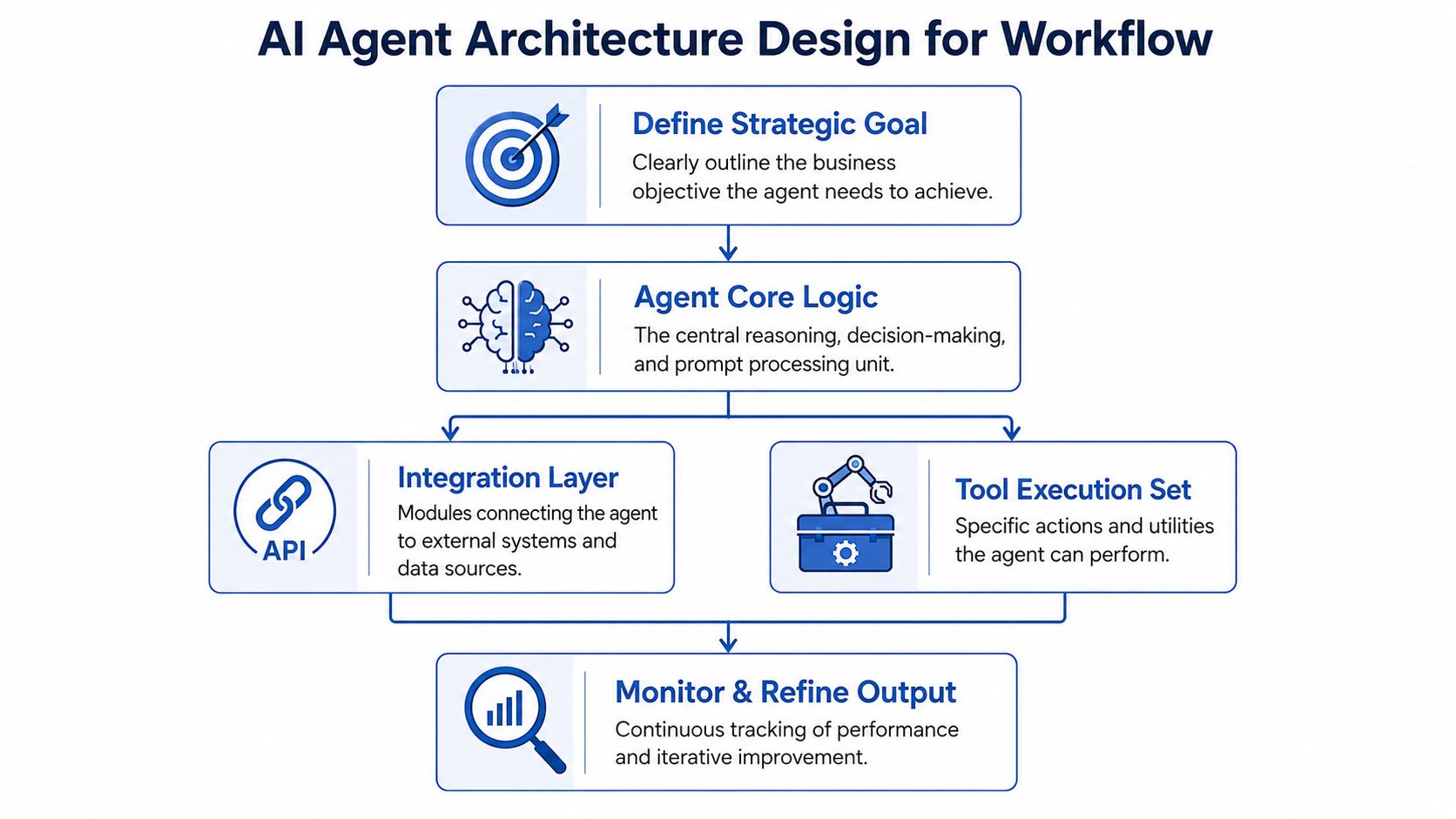
Architecture should match the shape of the work. Don't use a multi-agent system simply because it appears advanced. Use it when the workflow benefits from specialization and controlled handoffs.
When one agent is enough
A single agent works well when the task is linear and bounded. Think lead qualification, support categorization, report summarization, or internal document extraction.
The benefit is simplicity. Fewer moving parts. Easier debugging. Lower orchestration overhead.
Use a single agent when:
- The sequence is predictable: input, process, output
- Tool use is limited: maybe one or two systems
- Error impact is manageable: human review can catch problems quickly
When you need multiple agents
The minute the workflow becomes messy, a single agent starts to wobble. Research, planning, synthesis, validation, and execution are different jobs. One prompt trying to do all of that usually becomes brittle.
Benchmarking shows agents excel in structured environments, achieving 30-50% faster process times, but performance declines with complexity in multi-step real-world tasks, making multi-agent architectures with smart handoffs essential for reliable performance according to AIMultiple's performance analysis of AI agents.
That matches what I've seen in builds. Once complexity rises, you need division of labor.
A practical architecture I actually use
I usually break the system into roles like this:
| Agent role | Job in the workflow |
|---|---|
| Coordinator | Interprets the goal, assigns tasks, manages state |
| Research agent | Pulls data from sources, docs, web tools, or internal systems |
| Analysis agent | Compares inputs, finds patterns, flags anomalies |
| Writer or formatter agent | Turns outputs into summaries, tickets, reports, or updates |
| Validator | Checks for missing fields, policy issues, or confidence thresholds |
This isn't academic design. It's an operational one. Each role does less, so each role fails less often.
Multi-agent systems work best when each agent has a narrow job, a clear input, and a defined output. Wide-open autonomy looks impressive in demos and breaks in production.
The handoff matters more than the headline model
The weak point in most builds isn't reasoning. It's state management. If Agent A produces sloppy output, Agent B inherits garbage and the whole system drifts.
That's why I'm strict about schemas, checkpoints, and explicit transitions. If you need a clean mental model for those transitions, this piece on reliable server scheduling using Python is useful because state-machine thinking improves agent reliability fast.
For deeper implementation thinking, I've written about agentic context engineering in business workflows. Context is what separates a capable agent from an expensive guessing machine.
My decision rule
If the workflow is short, repetitive, and structured, start with one agent.
If the workflow spans multiple tools, requires intermediate checks, or mixes research with action, split it into specialized agents with explicit handoffs. That will feel slower at the start. It scales better later.
Building Your Agent with Advanced Prompts and Integrations
An AI agent without tools is just a smart text box. An AI agent without disciplined prompting is just a chaotic intern. You need both.
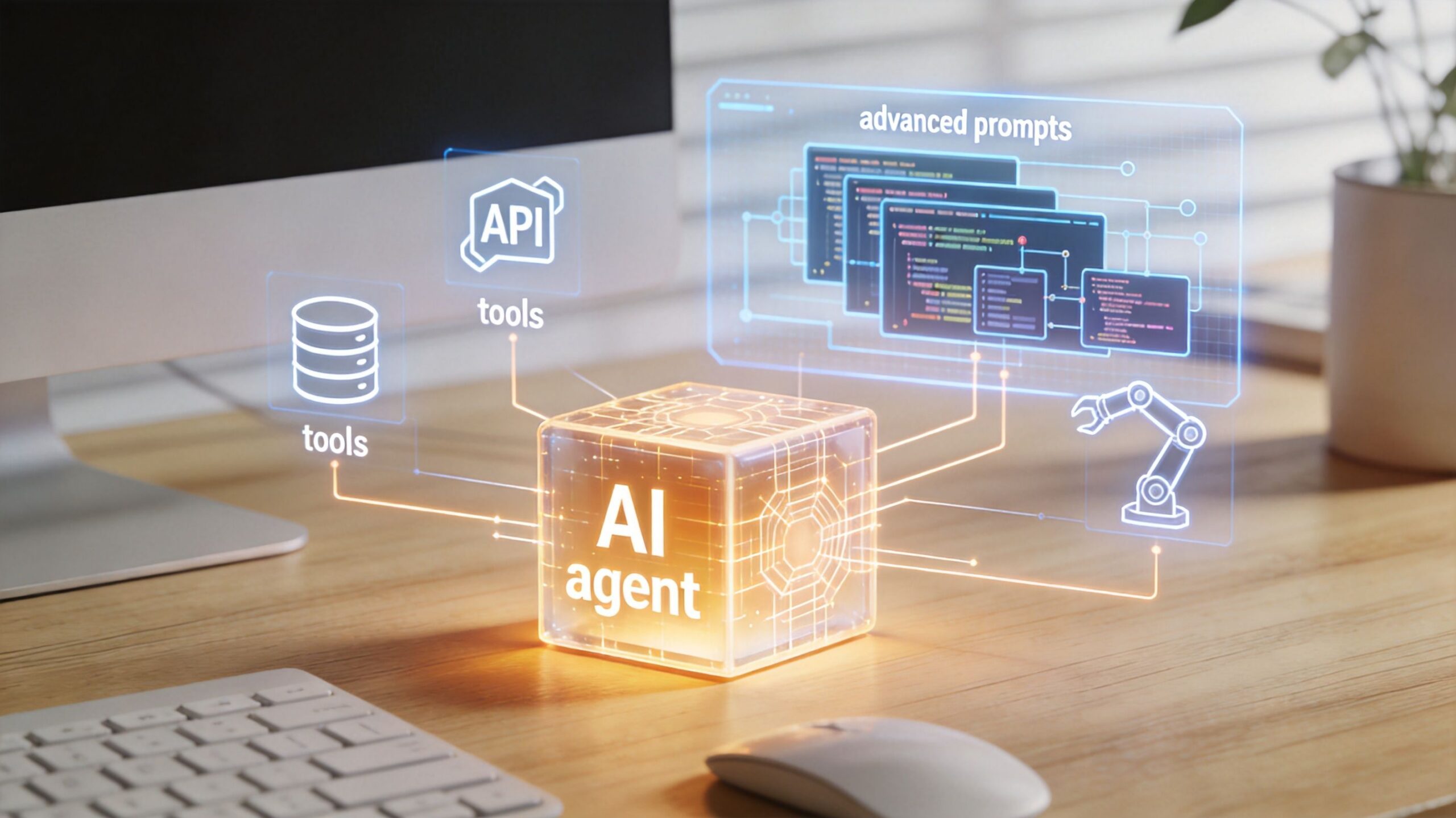
I keep the build process simple. First, define the agent's role and boundaries. Second, give it access to the minimum tools required. Third, force it to show its work in a structured way your systems can trust.
Prompt like an operator, not a copywriter
Most prompt advice online is weak because it was written for chat sessions, not production systems. In operations, your prompt has one job. Produce reliable action.
I use prompts with these components:
- Role definition: what the agent is responsible for
- Goal statement: the exact business outcome it should produce
- Constraints: what it can't do, what requires escalation
- Tool instructions: when to query, when to write, when to stop
- Output schema: the exact JSON, fields, labels, or action format required
- Fallback behavior: what happens with uncertainty, missing data, or conflicts
A useful pattern is ReAct-style behavior. The agent reasons, picks a tool, observes the result, then decides the next step. You don't need theatrical chain-of-thought in production. You do need clear intermediate decisions and visible tool usage.
Give the agent hands
Most real business value comes from integrations. Not from the model alone.
Your agent might need to:
- Read from CRM systems: pull account context, lead stage, owner, notes
- Check analytics tools: compare campaign performance or flag anomalies
- Update project tools: create tasks, assign owners, set due dates
- Trigger automations: send alerts, move records, request approvals
- Use retrieval systems: search internal SOPs, docs, and historical cases
For SMBs, I usually recommend a lean stack. APIs where available. RAG for internal knowledge. Basic orchestration. Then lightweight browser or RPA support only when an old system blocks progress.
A major gap in existing content is the lack of practical integration guides for SMBs using open-source LLMs. Adapting agentic workflows like RAG with multi-agent setups for marketing ops can yield 3-5x faster ROI for resource-constrained teams by avoiding vendor lock-in according to this analysis of operational AI gaps.
That's why I push founders away from overbuying. Start with capability. Keep your architecture portable.
A straightforward build stack
Here's a practical stack shape I like for SMB operations work:
Model layer
Use ChatGPT, Claude, Gemini, or an open-source LLM depending on budget, privacy needs, and task type.Orchestration layer
Use code-first logic or a light workflow layer to manage steps, retries, and handoffs.Knowledge layer
Add retrieval over internal SOPs, docs, playbooks, tickets, and reporting notes.Tool layer
Connect CRM, help desk, analytics, email, docs, and project management tools.Control layer
Log actions, require approval where needed, and track failure modes.
I also point teams to practical AI workflow automation tools for business systems when they need examples of what to connect first. And yes, my own Samuel Woods advisory work sits in this category too. I help companies design these tool-augmented workflows around their existing stack rather than forcing a rip-and-replace.
One example worth copying
Say you run a growth team. You can build an agent pipeline where one agent pulls campaign data, another compares it to benchmarks and prior periods, a third drafts insights, and a final validator checks for missing context before posting a summary into Slack or your project system.
That's not glamorous. It's profitable.
Here's a useful walkthrough to pair with that thinking:
What not to do
Don't start by wiring the agent into every system you own. Don't give it broad write access on day one. Don't ask it to handle vague, politically sensitive, or heavily exception-driven workflows before it has earned trust.
A disciplined agent with narrow powers beats a “fully autonomous” mess every time.
Deploying and Testing Your AI Agent in the Wild
A prototype proves possibility. Deployment proves value.
Rushing this stage often proves regrettable. It typically involves testing only happy-path prompts, declaring completion, and then experiencing surprise when the agent fails on messy real work. Production is where ambiguity, incomplete records, edge cases, and bad assumptions show up.
Start with shadow mode
My preferred rollout starts with the agent running beside your current workflow. It does the work, but a human still owns the final action.
That gives you a safe way to compare:
- Agent recommendation versus human decision
- Output speed versus current process
- Failure patterns across common scenarios
- Escalation frequency when the agent gets stuck
You'll learn more in a week of shadow mode than in a month of sandbox tinkering.
Run the agent where real work happens, but keep the blast radius small until you trust the pattern.
Build a test harness, not a vibe check
You need a set of scenarios that stress the system on purpose. Good testing includes clean cases, ugly cases, incomplete data, contradictory records, and policy-sensitive situations.
I typically create test sets like this:
| Test type | What it reveals |
|---|---|
| Standard cases | Baseline task performance |
| Missing-data cases | Whether the agent escalates correctly |
| Contradictory-input cases | How it handles conflict and uncertainty |
| Edge cases | Fragility in unusual but important scenarios |
| Tool-failure cases | Recovery behavior when integrations break |
If you skip this, you're not testing operations. You're testing optimism.
Roll out by workflow slice
I don't like big-bang launches. I like limited deployment by team, use case, or action type.
A strong sequence is usually:
Internal-only output
Summaries, drafts, recommendations. No direct customer or system changes.Assisted execution
The agent prepares actions, a human approves.Conditional autonomy
The agent can act on low-risk tasks inside strict rules.Expanded scope
Only after logs show consistency and the team understands the failure modes.
Watch the right signals
Don't just ask whether the agent “worked.” Track where it hesitates, where humans override it, and where tools fail underneath it.
The signs I care about are practical:
- Completion quality: did it produce usable output
- Escalation discipline: did it ask for help when it should
- Override frequency: how often humans had to correct it
- Recovery behavior: what happened after tool or data failures
- Operational trust: whether the team wants to use it again
If your team doesn't trust the output, your deployment isn't finished. It doesn't matter how clever the architecture looks on a whiteboard.
How to Measure the True ROI of Your AI Agent
If you measure AI by “number of prompts” or “tasks touched,” you'll fool yourself. The only ROI that matters is operational and financial.

The good news is that AI agents already have a serious business case. Companies using AI agents report compelling ROI, with 60% seeing returns within 12 months, driven by 25-30% productivity gains and an average of 35% cost reductions. Some have seen an ROI as high as 30:1 within 18 months according to these enterprise AI agent ROI statistics.
Measure in four layers
I use a simple scorecard.
1. Direct labor leverage
This is the easiest place to start. How much human time did the agent remove from repetitive work?
Look at tasks like reporting prep, intake triage, research gathering, internal summaries, and handoffs. If the team spends less time on low-value coordination, that's recoverable capacity.
2. Cost impact
Founders often pay attention to this. Did the workflow become cheaper to run?
That can show up as fewer manual hours, reduced operational waste, fewer errors requiring rework, or less dependence on outside support for routine processing.
3. Speed to action
Faster decisions create commercial advantage. An agent that gets the right information to the right person sooner can help your team launch faster, resolve faster, and adjust faster.
This is especially important in marketing, support, ecommerce, and sales operations where lag kills momentum.
4. Quality and control
Cheap and fast mean nothing if the output is unreliable. Track quality signals with the same seriousness as cost savings.
I look at:
- Human override rate: how often the team fixes or rejects output
- Escalation quality: whether the agent knows when to stop
- Rework load: whether hidden manual cleanup is rising
- Consistency: whether the same input gets a stable result
Revenue lens: The best agent ROI often comes from faster execution and cleaner decisions, not just lower admin cost.
Build an ROI dashboard your leadership team can actually use
Don't dump raw system logs into a spreadsheet and call it strategy. Build a simple dashboard tied to the workflow.
For each agent, include:
| Metric | Business meaning |
|---|---|
| Time saved | Recovered team capacity |
| Cost per task | Operating efficiency |
| Human overrides | Trust and quality signal |
| Escalations | Risk control and exception handling |
| Throughput speed | Competitive execution advantage |
If you're a founder, this lets you decide where to expand. If you're a CMO or operator, it gives you evidence for budget and hiring choices. If you're an agency leader, it shows clients whether your AI workflow is improving delivery.
The key is discipline. One workflow. One scorecard. One real financial story.
Your Next Move The Path to Market Domination
The teams that get value from AI agents don't wait for perfect certainty. They pick one painful workflow, build a narrow solution, and force it to prove itself in operations.
That's your move.
Do these three things next
Pick one high-friction workflow
Choose something repetitive, cross-functional, and annoying enough that people will welcome change. Reporting, routing, research, triage, or handoff management are strong candidates.Scope a minimum viable agent
Give it a narrow role, a small toolset, and a clear escalation path. Don't chase full autonomy. Chase dependable usefulness.Deploy, measure, and expand only after proof
Run it in shadow mode. Review output. Track labor efficiency, cost impact, speed, and trust. Then widen the scope.
What this enables against competitors
Your competitors can still copy your product page, your pricing ideas, and your ad angles. It's harder for them to copy your operating speed once it's embedded in your workflows.
That's why I treat the ai agent for operations and workflow shift as a strategic weapon, not a convenience feature. It changes how fast your company learns, how fast it acts, and how much output you can produce without adding matching headcount.
Build one agent that removes real friction. Then build the second on top of that win. Momentum matters more than ambition.
The founders who win this cycle won't be the ones with the most AI subscriptions. They'll be the ones who turned AI into operational muscle early, while everyone else was still shopping for software.
If you want, I can turn this into a follow-up piece with a concrete SMB implementation stack for marketing ops, support ops, or ecommerce ops using ChatGPT, Claude, and open-source components.