
The market segmentation strategies that work are the ones you can activate. Build each segment from behavioral data first, such as purchase history, usage frequency or feature adoption, then store it as one persistent field your CRM, email tool and ad platforms can all read. If a segment can’t change a message or an offer this week, it isn’t ready.
Most market segmentation strategies fail for a boring reason. The team builds a beautiful persona deck, then nobody can turn it into a CRM field, an audience list, or a message that an AI agent can use without guessing.
I learned that the hard way on my first segmentation project. I had clean slides, sharp labels, and a pile of “insight,” but the segments didn't survive contact with real systems. The tell was simple, the same campaign kept getting routed to the same broad list because there was nowhere durable to store the segment logic.
A segment only matters if you can activate it. If you can't push it into email, paid media, and sales workflows, you've built a description, not a decision system.
Table of Contents
- Why Most Segmentation Projects Fail Before They Start
- Choosing the Right Segmentation Bases for Your Business
- Preparing Data and Setting Sample Size Requirements
- Building Segments with Analytics and LLMs
- Validating and Activating Segments in Your Systems
- Designing Privacy-Safe Segments That Last
- Your Monday Morning Implementation Plan
Why Most Segmentation Projects Fail Before They Start
The usual mistake is starting with a workshop and ending with a poster. People pick a few demographics, add a layer of psychographics, then call the result a strategy. That feels smart in a deck, but it often collapses as soon as a CRM, ad platform, or automation rule needs a field it can read.
That failure mode has a long history. Market segmentation became a recognized marketing strategy in 1956 when Wendell R. Smith published “Product Differentiation and Market Segmentation as Alternative Marketing Strategies,” while earlier practical advertising had already used tax registers, city directories, and census data to sort consumers by education and earning capacity. Later, Daniel Yankelovich pushed the field beyond age and income toward attitudes and behavior, which is why modern segmentation mixes multiple variables instead of worshipping one trait. The core lesson is still the same, segments have to be targetable, measurable, and stable.
Decorative segments look insightful and do nothing
The first time I built segments, I made them too abstract. They sounded smart, but they didn't map to a CRM property, and they didn't cleanly become ad audiences. I was looking at my own slides and feeling good about the wording, which was the wrong signal entirely.
Practical rule: if you can't assign the segment to a record, a list, or a rule, it's decoration.
I also see teams stop at “understanding customers,” then never ask whether the labels can drive this quarter's revenue decisions. That gap is where most projects die. If you want a fast way to pressure-test the idea before you build anything heavy, a market research workflow like Zemith market research tool can help you see whether the audience groups you want are distinct enough to matter.
The signal that told me the segment was fake
The clearest warning sign was when every segment got the same email, the same ad copy, and the same follow-up. At that point, the segments were cosmetic. They changed the language inside the team, not the customer experience.
A lot of conventional advice starts with demographics because they're easy to collect. That's fine for a first pass, but demographics alone often produce clusters that look orderly and act alike only on paper. If the segments can't be operationalized in your stack, you'll spend time managing labels instead of revenue.
Choosing the Right Segmentation Bases for Your Business
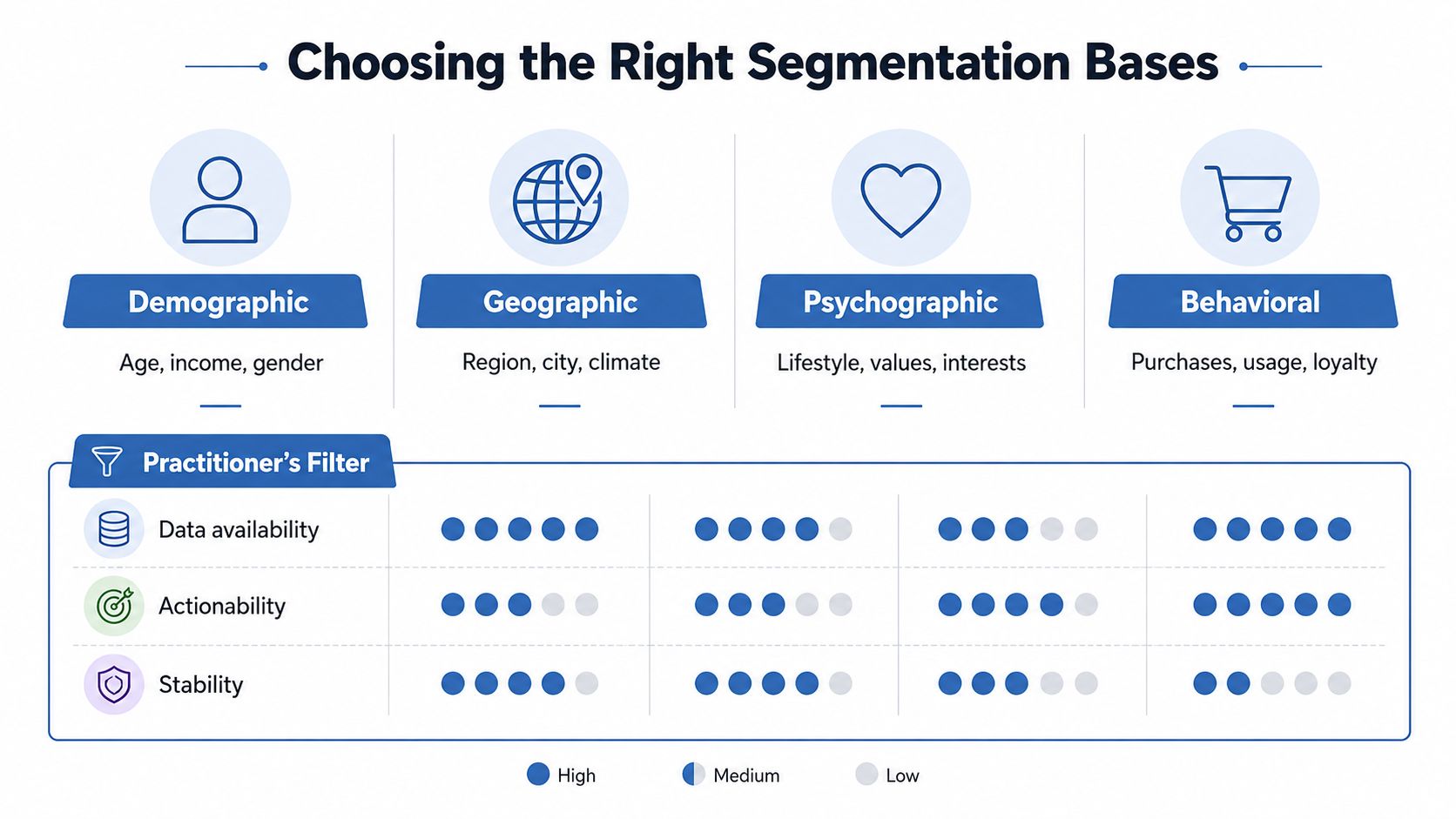
The four classic bases are demographic, geographic, psychographic, and behavioral. I use them in that order only when the business is tiny and the data is thin. As soon as I can, I move the center of gravity toward behavior, because behavior is what people do.
Demographic and geographic still have a job
Demographic segmentation uses traits like age, income, education, and family size. It earns its keep when your product price, format, or use case clearly changes by life stage. It fails when you treat it as a proxy for intent and stop there.
Geographic segmentation matters more for local businesses than most guides admit. If you sell into regions with different climate, shipping speed, or local norms, geography is a real constraint, not a nice-to-have filter. For an online business, it becomes useful when location affects logistics, legal requirements, or offer relevance.
Psychographic data needs a lighter touch
Psychographic segmentation uses values, lifestyle, and personality. You do not need an expensive panel to start collecting it. Short on-site surveys, preference centers, and a few open-text prompts can surface enough signal to guide positioning, as long as you don't pretend that a handful of answers is a full psychology profile.
The mistake is overbuilding psychographics before you have a working behavioral base. I've seen people ask 30 questions to create a beautiful “identity” segment that never changed a campaign decision. If the result can't change subject lines, offers, or landing-page copy, it's too abstract.
Behavioral segmentation usually wins
Behavioral segmentation tracks usage frequency, feature adoption, engagement level, purchase history, and buyer-readiness stage. That's why I prefer it for most online businesses. It reflects what customers do, not what they say they are.
A survey-based segmentation framework should separate the four bases (demographic, geographic, psychographic and behavioral) cleanly so the output is actionable, not descriptive. Yalc's outbound playbook is a good reference if you want to see how segment logic can shape outreach without turning into generic targeting. The useful test is simple, if a segment cannot change the next action, it shouldn't exist yet.
Preparing Data and Setting Sample Size Requirements
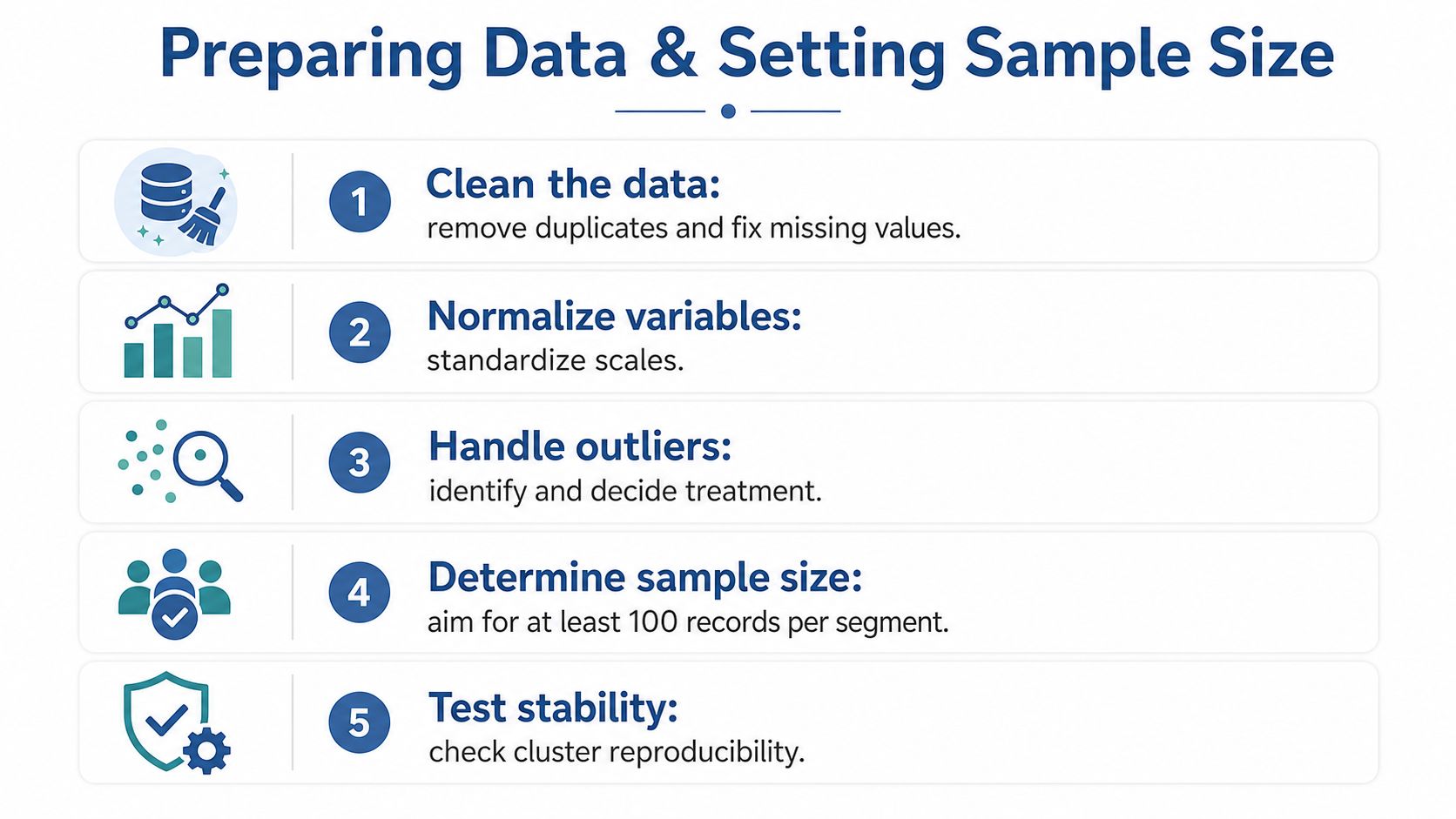
Bad data ruins segmentation faster than bad math. Duplicate records, missing values, mixed scales, and unfiltered outliers all create false clusters that look confident until you try to use them. If you're working from a small team stack, the goal is not statistical theater, it's stable groups you can trust in production.
Start with the sample, not the model
One practical methodology recommends at least 500 to 600 respondents for a basic 3 to 5 segment solution, and 800 to 1,200+ when you need deeper subgroup analysis or more complex structures. Those thresholds matter because small samples make clusters wobble. If your data is too thin, the model will still produce segments, but they'll often move around when you rerun it.
I keep the internal data prep in this order.
- Clean the records. Remove duplicates and fix missing fields before modeling.
- Normalize the variables. Put scales on comparable footing so one noisy field doesn't dominate the result.
- Handle outliers deliberately. Decide whether they represent a real edge case or corrupted input.
- Check sample adequacy. If the segment count is high and the sample is low, stop.
- Test reproducibility. Rerun with split samples and alternate random seeds.
Survey data and behavioral data answer different questions
Survey data is useful when you need stated preferences, motivations, or attitudes. Behavioral data is stronger when you want to see actual usage and buying patterns. I usually combine them only after the behavioral base is stable, because mixed inputs can create contradictory clusters if you don't clean the logic first.
The internal trade-off is simple. Survey data gives you context, but it can drift from reality. Behavioral data gives you reality, but it may miss the “why.” If you want both, decide which one is the anchor and which one is the enrichment layer.
For a practical implementation path, I've found it easier to connect segmented customer records to a shared data layer first, then validate the outputs. My own notes on that workflow live in this AI customer data platform guide, because the storage layer usually breaks before the clustering logic does.
Building Segments with Analytics and LLMs
The work stops being theoretical when I build the segments in analytics, then use an LLM to help name them, summarize them, and suggest messaging hypotheses. The model should read the cluster, not invent a new one.

The workflow I actually use
I start with prepared data, then run clustering in a tool that can handle the sample size and variable mix. K-means works when the variables are clean and roughly numeric, while hierarchical clustering helps when I want a structure I can inspect more manually. I don't care which method sounds smarter, I care whether the segments are distinct enough to act on.
Then I feed the cluster summary into an LLM with a tightly bounded prompt. A prompt that works looks more like this.
Prompt: “You are analyzing customer clusters from structured data. Use only the fields below. Do not invent motivations, demographics, or behaviors not present in the data. For each cluster, give a plain-English name, a one-sentence description, the strongest observable signals, and three messaging hypotheses tied to those signals.”
I review the output against the raw variables. If the model says a cluster is “career-driven” but none of the fields support that, I discard the label. The model is useful for turning analyst notes into readable segment language, but it gets slippery when it starts filling gaps with confident fiction.
What manual rule-based segmentation still does better
Manual rules work well when the dataset is small and the business logic is obvious. If you only need to separate first-time buyers from repeat buyers, or high-usage from low-usage customers, a rule set is often faster and easier to maintain. You also get more control when the team will need to edit the definition without reopening a modeling pipeline.
I wrote up a fuller comparison of model choice in which LLM is the best, but the short version is this. Use AI to explain and operationalize clusters, not to hallucinate them into existence.
The failure mode nobody warns you about
The biggest mistake is letting the LLM talk you into prettier segments than the data supports. That happens when you ask for “insight” instead of evidence. If a cluster can't be described using the actual fields in the model, it's too vague to trust.
Validating and Activating Segments in Your Systems
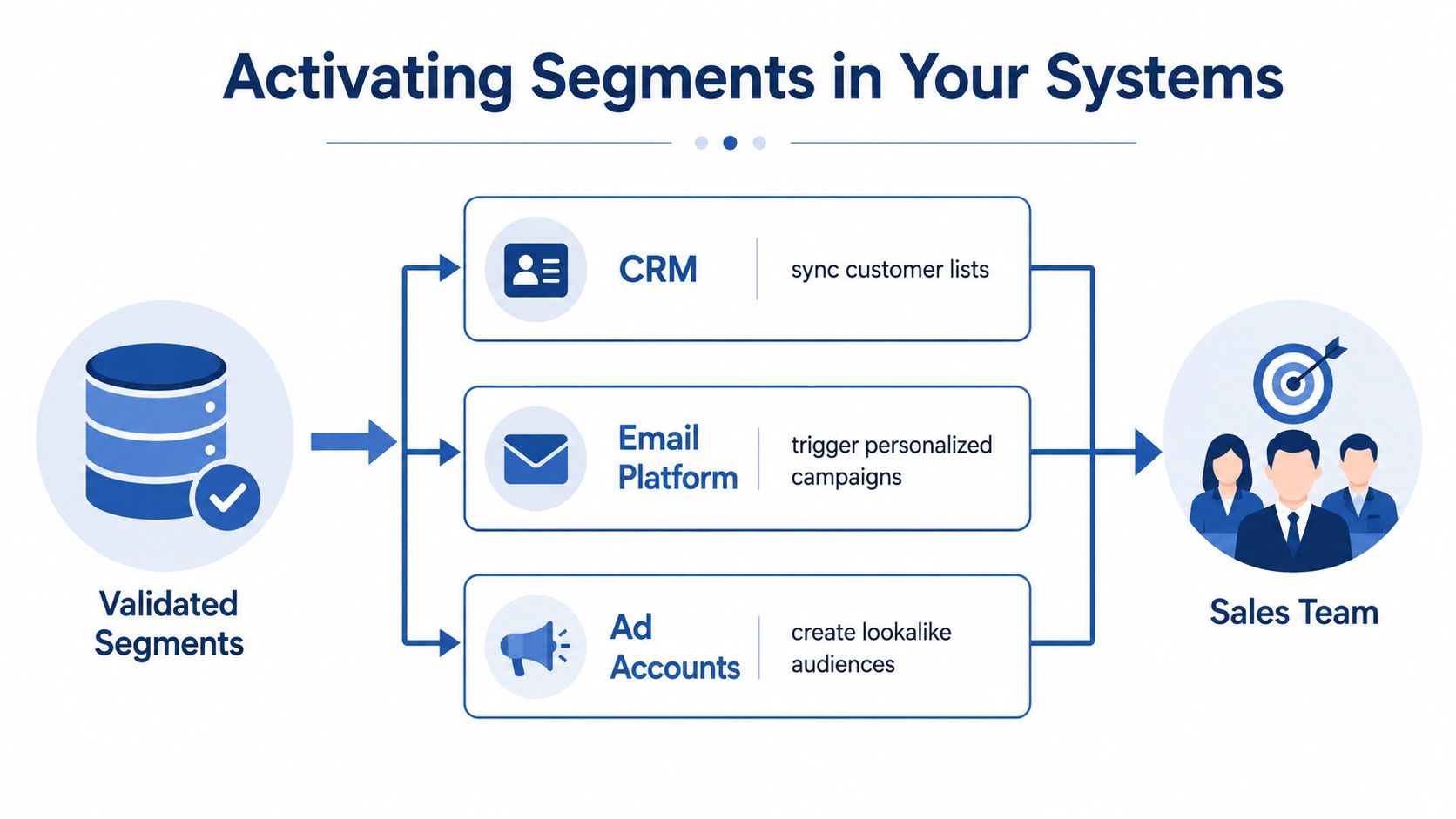
A segment that stays in analytics is dead weight. The test is whether it can travel into CRM, email, ads, and sales without breaking apart. This is also where a lot of teams find out their “strategy” was just a naming convention.
Push the segment into fields, not slides
I start by translating each segment into one durable identifier, usually a tag or custom field that every system can read. Then I sync that field into the CRM first, because the CRM is where routing, follow-up, and list hygiene usually get messy. After that, I map the same logic into email and paid media.
The sequence matters.
- Validate the segment definition. Confirm that the cluster is stable and named in plain language.
- Create a persistent field. Use a tag, property, or audience label that won't vanish after one export.
- Sync to CRM. Make sure sales can see it.
- Mirror it in email. Trigger segment-specific sequences without creating a dozen fragile branches.
- Build ad audiences. Turn the same logic into platform lists where possible.
- Track lift by segment. Compare conversion, acquisition cost, and value by segment.
For the execution layer, analyze experiment segments is the kind of resource I'd send to anyone trying to verify whether a segment changed outcomes rather than just dashboards.
What to measure, and what to ignore
I care about conversion rate by segment, customer acquisition cost by segment, and lifetime value by segment. If those metrics don't move in the right direction, the segmentation effort hasn't paid for itself yet. I ignore vanity labels like “engagement” unless they tie to a downstream decision.
For email, I keep the branching shallow. Segment-specific messaging works better when it changes the offer, proof, or timing, not every line of copy. If the workflow turns into a maintenance nightmare, the segment design is too fine-grained.
If you want a practical email structure to adapt, I've kept notes in email segmentation best practices. The main lesson from production is that segments fail most often at the handoff, not in the model.
Where activation breaks
Activation usually breaks for three reasons. The field doesn't persist across systems, the segment is too small to target reliably, or the audience definition changes every time the data refreshes. When that happens, I tighten the logic, reduce the number of active segments, and stop pretending every cluster deserves a campaign.
Designing Privacy-Safe Segments That Last
Privacy rules change the shape of segmentation whether you like it or not. If your strategy depends on third-party data or brittle identifiers, the segment can disappear the moment consent shifts. I build for first-party behavior first, because that survives more of the actual world.
The current gap is clear. A lot of guidance still treats segmentation as a short-term planning tool, while many organizations only apply it to decisions inside a one-year horizon. That approach makes segments fragile. It also encourages teams to collect more data than they can safely activate.
Build around consent and first-party signals
The cleaner path is server-side tracking, hashed email matching, and cohort logic that can still work when deterministic identifiers are missing. If a user opts out of a data path, I don't force the segment to collapse. I move to a broader behavioral cohort and keep the messaging relevant without pretending I have more precision than I do.
That means designing segments that can degrade gracefully.
- If identity is available, use it for direct activation.
- If identity disappears, fall back to cohort behavior.
- If consent narrows, reduce the detail in the segment, not the usefulness of the offer.
The other mistake is building micro-segments on shaky proxy data. If a demographic proxy is only there because it's easy to buy or scrape, I usually drop it. Privacy-safe segmentation is more durable when it starts from observed behavior and explicit consent.
Use fewer segments that can survive contact with the stack
I've found that fewer, clearer segments are easier to keep compliant and easier to refresh. The old idea that more segments always means better precision breaks in production because every extra group creates more storage, more routing, and more points of failure. The segment should survive a CRM sync, an ad platform limitation, and an AI workflow that needs clean inputs.
That's also why I care about operational design as much as audience theory. A future-proof segment is one that still makes sense after the data gets narrower.
Your Monday Morning Implementation Plan
Start small. If you're a solo operator or a team under ten, build one segment from one behavioral signal and one optional enrichment layer. Don't start with six personas and a workshop deck.
I'd do this on Monday.
- Pick one business decision. Renewals, first purchase, or reactivation. One.
- Choose one behavioral signal. Usage frequency, recent purchase, or feature adoption.
- Add one enrichment layer. Geography or a short preference question.
- Create one persistent field. Make it readable in your CRM and email tool.
- Write two message variants. One for the segment, one for everyone else.
- Run a two-week test. Watch conversion rate, acquisition cost, and reply rate.
If the segment can't change a message this week, it's not ready.
A good minimum viable project is one segment, one audience export, one email branch, and one ad audience. If that works, expand. If it doesn't, stop adding variables and inspect the data quality, the sample size, and the activation path.
I'd skip advanced clustering entirely if you have sparse data or no clean way to move segments across systems. In that case, rule-based segmentation is usually the better choice. Use the simplest segment that changes a real decision, then let performance tell you whether it deserves to grow.
If you want more systems like this, follow the weekly builds at Bionic Business on bionicbusiness.com, where I keep documenting the workflows, prompts, and failures that turn segmentation from a slide into something you can run this week.
Frequently Asked Questions
What are the four bases of market segmentation?
The four classic bases are demographic, geographic, psychographic and behavioral. Demographic data helps when price or use case changes by life stage. Geography matters when location affects shipping, legal requirements or offer relevance. Psychographic data can come from short surveys and preference centers. Behavioral data, such as usage frequency and purchase history, usually makes the strongest base for an online business because it reflects what customers do.
How large a sample do you need for customer segmentation?
One practical methodology recommends at least 500 to 600 respondents for a basic three to five segment solution, and 800 to 1,200 or more for deeper subgroup analysis. Smaller samples still produce clusters, but they tend to move around when you rerun the model. Clean duplicates, normalize variables and handle outliers first, then test reproducibility with split samples and alternate random seeds.
Can I use ChatGPT or another LLM to build customer segments?
Build the clusters in an analytics tool first, using k-means for clean numeric variables or hierarchical clustering when you want a structure you can inspect. Then give the cluster summary to an LLM with a tightly bounded prompt to name the segments, describe them and suggest messaging hypotheses. Check every label against the raw fields and discard anything the data doesn’t support.
When is rule-based segmentation better than clustering?
Manual rules work better when your dataset is small and the business logic is obvious, such as separating first-time buyers from repeat buyers or high-usage from low-usage customers. Rules are faster to set up, easier to maintain, and easy to edit without reopening a modeling pipeline. Skip advanced clustering entirely if your data is sparse or you have no clean way to move segments between systems.
How do you activate a segment in your CRM, email and ads?
Turn each validated segment into one durable identifier, such as a tag or custom field every system can read. Sync it into your CRM first, then mirror it in email sequences and build matching ad audiences. Track conversion rate, acquisition cost and lifetime value by segment. If the field doesn’t persist across systems or the segment is too small to target, tighten the logic and cut the number of segments.
How do you keep market segmentation privacy-safe?
Build segments on first-party behavior and explicit consent instead of third-party data or brittle identifiers. Server-side tracking, hashed email matching and cohort logic keep segments working when deterministic identifiers disappear. Design each segment to degrade gracefully: use identity when you have it, fall back to cohort behavior when you don’t, and drop demographic proxies that exist only because they were easy to buy or scrape.